

 Home
HomeHow Review Volume Shapes Business Credibility
 Category:Articles
 June 13, 2026 / AT: 9:27 AM
 130 View
 No Comment
Key Takeaways
Review volume builds buyer confidence by signalling authenticity and consistency, making it a core driver of business credibility in competitive local markets.
- A higher number of reviews signals that a business is established and trusted by the broader community, directly influencing whether a potential customer chooses you over a competitor.
- Volume supports your star rating by giving it statistical legitimacy. A 4.5 rating from 300 reviews is far more convincing to buyers than a 4.9 rating from 6 reviews.
- Consistency in collecting reviews matters as much as volume. A long gap in new reviews raises authenticity concerns for both buyers and search platforms, which can hurt local visibility.
- Buyers evaluate recency, response behaviour, and total count together. Responding to reviews and gathering fresh feedback regularly signals accountability and active customer engagement.
- Automating the review request process through tools like NPS surveys sent shortly after a transaction helps small business owners build a steady, credible review profile without heavy manual effort.
For any small business operating in a competitive local market like Vancouver, understanding how review volume affects business credibility is not abstract. It is the difference between a potential customer choosing your business or scrolling past it. When someone lands on your Google listing or Facebook page, the first things they notice are not your mission statement or your years in operation. They notice your star rating and how many people have reviewed you. That number tells a story before a single word of feedback is read.
Understanding how online reviews influence customer trust requires looking beyond the surface level. Review count acts as a form of social proof, a signal that real people have engaged with your business and found it worth commenting on. This article explains what review volume means for buyer confidence, where the credibility threshold sits, and what small business owners can do to build a review profile that works consistently in their favour.
Why the Number of Reviews Matters to Buyers
Buyers use reviews to reduce uncertainty before spending money. When someone is choosing between two similar businesses and one has 12 reviews while the other has 148, the difference communicates something powerful. The business with more reviews appears more established, more active, and more trusted by the broader community. According to BrightLocal, 98% of consumers read reviews before making a purchase, which means almost no one skips the review check entirely.
The psychology behind this is rooted in the wisdom of the crowd. When more people have weighed in on a business, the risk of making a bad choice feels lower. A business with a single glowing review could simply be a friend or family member. A business with 200 reviews, even if some are mixed, feels real. In Vancouver’s Lower Mainland, where consumers across neighbourhoods like Kitsilano, Mount Pleasant, and Commercial Drive have no shortage of local options, that sense of realness can be the deciding factor. Review quantity and trust are directly linked in the consumer mind, and businesses that ignore this connection often lose leads they never knew they had.

How Review Volume Affects Credibility Beyond the Star Rating
Star ratings get noticed first, but they do not carry equal weight in every situation. A business sitting at 4.9 stars from 6 reviews is statistically unreliable in the eyes of most buyers. A business at 4.5 stars from 300 reviews tells a much more convincing story. This is the practical meaning of review volume: quantity creates the statistical base that makes a rating feel legitimate. Research published in the International Journal of Research and Scientific Innovation confirms that businesses with a large number of reviews tend to be perceived as more credible and more representative of real customer experience.
Volume and rating work together, but volume lays the foundation. Without enough reviews, even an exceptional rating feels fragile. Buyers know, consciously or not, that a small sample can be skewed. A business that consistently grows its review count over time builds a reputation that is much harder to dismiss or doubt. For small business owners, that means chasing a perfect score is less productive than building a consistent, growing body of authentic feedback.
| Review Profile | Star Rating | Review Count | Buyer Confidence |
|---|---|---|---|
| Low volume, near-perfect score | 4.9 | 6 | Low — sample too small to trust |
| Moderate volume, strong score | 4.5 | 300 | High — rating feels legitimate |
| High volume, mixed score | 4.0 | 500 | Medium-high — feels real and established |
What Buyers Look for in a Review Profile
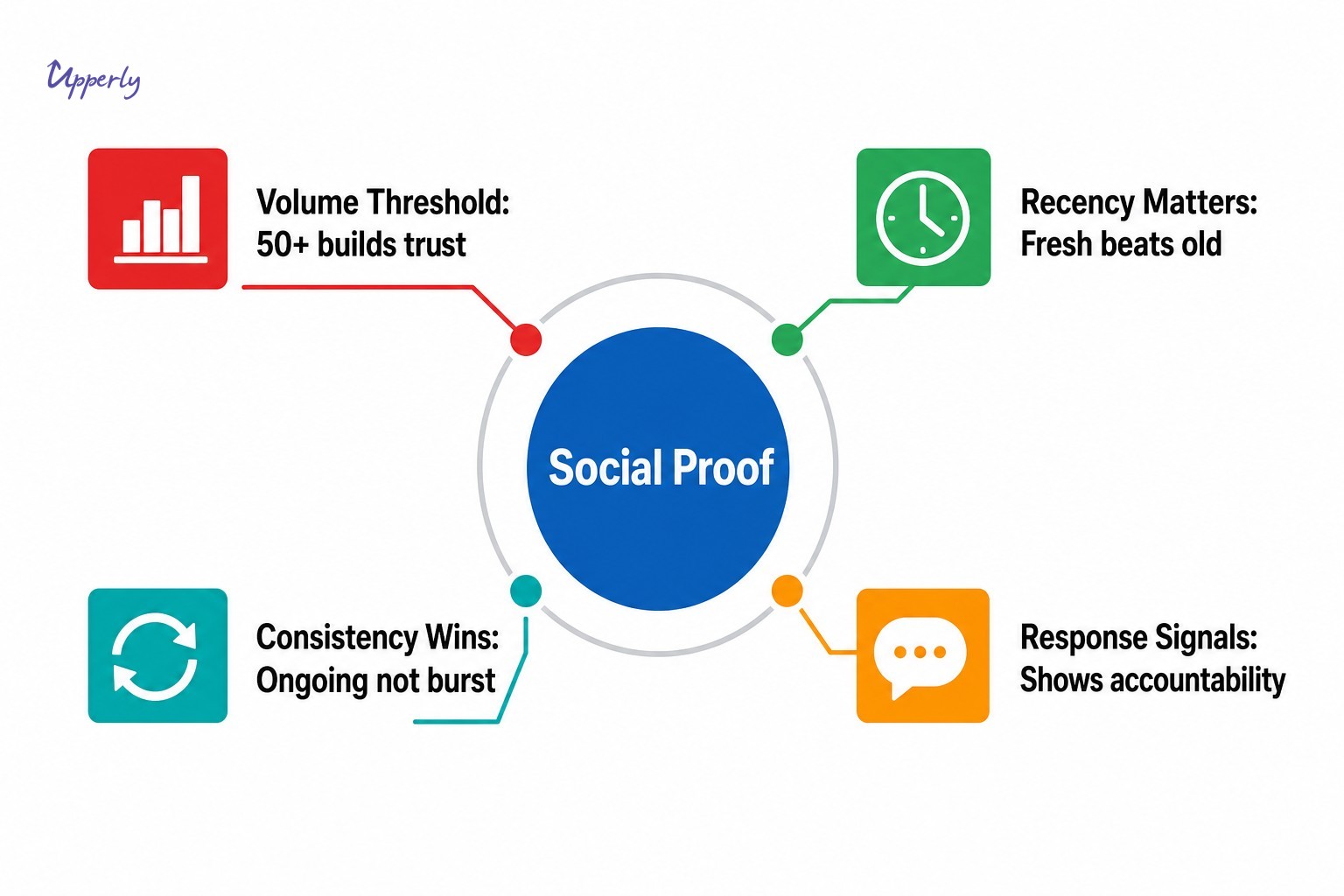
When buyers scan a review profile, they evaluate more than the total count. They look at how recent the reviews are, since older reviews suggest a business may have changed or stopped engaging with customers. They also check whether the business responds to feedback, as replies to both positive and critical reviews signal accountability. Finally, they assess whether reviews reflect genuine, specific experiences, since vague or generic comments carry less weight.
Review recency and customer decision making are closely connected. Buyers want to know a business is still performing well today, not two years ago. Together, recency, total count, and response behaviour form the review profile buyers use to decide whether a business deserves their trust and their money.
Review Quantity and Trust in Vancouver: Where the Threshold Lies
How many reviews does a business need before buyers trust it? Research points to a minimum of 4 to 10 reviews as the entry-level floor, but in competitive local markets, that is rarely enough to stand out. The importance of review count also varies by industry. A restaurant competing for lunchtime traffic in Vancouver’s Gastown or Yaletown needs substantially more reviews than a niche contractor with fewer direct alternatives.
For service businesses where the stakes feel higher, such as legal, health, financial, or home improvement services, buyers tend to require more evidence before committing. According to BrightLocal, 94% of consumers are more likely to use a business with positive reviews. The practical implication is straightforward: building toward a meaningful review count should be an ongoing priority, not a milestone reached and forgotten.
| Business Type | Minimum Reviews for Credibility | Recommended Target | Stakes Level |
|---|---|---|---|
| Restaurant / Café | 20 to 30 | 100+ | Low to medium |
| Retail shop | 10 to 20 | 50+ | Low to medium |
| Home improvement / Trades | 20 to 40 | 75+ | Medium to high |
| Legal / Financial services | 30 to 50 | 100+ | High |
| Health / Medical services | 30 to 50 | 100+ | High |
| Niche contractor | 10 to 15 | 30+ | Medium |

Why Volume Without Consistency Falls Short
A common pattern among small businesses is an initial burst of review collection followed by a long period of inactivity. This creates a recognisable red flag for both buyers and search platforms. A business that received 40 reviews in a single month two years ago and has collected only 3 since then raises questions. It suggests something changed, that the early reviews may have been encouraged artificially, or that the business is no longer as active or attentive.
Consistency is what separates a credible review profile from one that looks managed or manipulated. It is also worth noting that how star ratings shape first impressions depends heavily on whether the review volume supporting that rating feels current and ongoing. A static profile communicates stagnation regardless of its overall score. Search platforms also factor review recency and activity into local ranking algorithms, which means consistent collection supports both buyer confidence and discoverability. For businesses in Vancouver trying to stay visible in a busy market, that connection is commercially significant.
The Risk of Treating Reviews as a One-Time Task
When businesses treat review collection as a campaign rather than a continuous process, the effects accumulate over time. Rankings can slip as fresher competitors accumulate more recent feedback. Returning visitors notice that nothing has changed in the review section. Buyers comparing options in real time tend to choose the business that looks more actively engaged.
There is also a trust dimension to consider. BrightLocal research finds that 75% of consumers are concerned about review authenticity, and 88% oppose AI-generated reviews on review platforms. Buyers are increasingly alert to profiles that look manufactured. A sudden spike followed by silence fits the pattern of inauthentic behaviour, even when the reviews were perfectly legitimate. Steady, ongoing collection is one of the clearest signals that a business is genuinely engaged with its customers.

Building a Reliable Review Collection Process
The most effective way to build consistent review volume is to make the process automatic rather than manual. Asking customers individually, case by case, is unsustainable for most small business owners. Automated follow-up emails sent after a transaction or service interaction reach customers while the experience is still fresh, which is when they are most likely to respond. A request sent within a day or two of a positive experience tends to generate higher response rates than one sent weeks later.
Tools like automated review collection and NPS surveys simplify this for small business owners who do not have dedicated marketing teams. An NPS survey asks customers a single satisfaction question on a scale of zero to ten, identifies happy customers, and guides them toward leaving a public review on platforms like Google, Facebook, Yelp, or the BBB. This approach can generate more reviews while filtering for genuine satisfaction, which directly addresses buyer concerns about authenticity.
Research from the Spiegel Research Center at Northwestern University also supports the value of review quality within that volume: longer reviews of over 50 words tend to generate notably more engagement than shorter ones. Prompting customers with thoughtful follow-up questions can further strengthen the credibility of the reviews you collect.
Choosing the Right Review Management Tool
Selecting a review management platform is a practical business decision. Small business owners should assess setup complexity, looking for tools with a clear onboarding process and support for first-time users. Cost structure matters too, as flexible or pay-as-you-go options let you test effectiveness before locking into a subscription. Employee-level feedback tracking is also worth considering, since the ability to tie reviews to specific staff members helps identify service strengths and gaps before they become publicly visible.
Upperly is built around exactly these needs. With no mandatory subscription required, options starting from a low entry point, a done-for-you setup service for busy owners, and the ability to collect feedback tied to specific employees, it offers a practical, low-barrier approach that makes consistent review collection achievable for small businesses across Vancouver. If you are ready to build a review profile that works for your business over the long term, Upperly makes it straightforward to start.
Frequently Asked Questions
How many reviews does a Vancouver business need to appear credible?
Research suggests a minimum of 4 to 10 reviews to establish a baseline, but this is rarely enough in a competitive market like Vancouver. Most buyers feel more confident with businesses that have 50 or more reviews. High-stakes service industries, such as legal, health, or financial services, typically require more before customers commit.
Does a high star rating matter more than the number of reviews?
Both matter, but review volume provides the foundation that makes a rating believable. A 5-star rating from 5 reviews carries far less weight than a 4.5-star rating from 200 reviews. Buyers tend to discount ratings that are not supported by a substantial number of responses.
How often should a business be collecting new reviews?
Reviews should arrive on a consistent, ongoing basis rather than in one-time bursts. Even a steady flow of a few reviews per month is more convincing to buyers and search platforms than a large batch collected years ago. Consistency signals that the business remains active and attentive to its customers.
Can responding to reviews improve a business’s credibility?
Yes. Responding to both positive and critical reviews demonstrates accountability and shows potential customers that the business takes feedback seriously. It also adds visible activity to the review profile, reinforcing the impression that the business is engaged and well-managed.
What is the best way for a small business to collect more reviews?
Automated follow-up messages sent shortly after a transaction or service interaction are among the most reliable methods. Reaching customers while the experience is still fresh tends to produce higher response rates. Tools that include NPS surveys can help identify satisfied customers and guide them toward leaving public reviews on platforms like Google or Facebook.
Social Share



How to Turn Customer Feedback into Better Reviews
Key Takeaways Turning customer feedback into better reviews requires a connected system that segments sentiment, times requests strategically, and closes the loop between private…


What is SEO and how can it be improved by getting reviews?
The SEO is derived from the expression "Search Engine Optimization" which has equivalent words such as SEO or search engine optimization, all of which are…

Responding to Negative Google Reviews
When you ask our customers for reviews, you should know that all feedback will not be positive. There are those who give negative google reviews…

Why Customers Leave Negative Reviews and How to Close the Gaps
Key Takeaways Negative reviews follow predictable patterns of unmet expectations and service gaps that businesses can intercept before dissatisfaction goes public. Most negative reviews stem…