

 Home
HomeHow to Choose NPS Software That Drives Real Retention
 Category:Articles
 July 7, 2026 / AT: 5:04 PM
 3 View
 No Comment
Key Takeaways
A structured framework for CX managers in Vancouver to evaluate NPS software based on delivery, reporting, CASL compliance, pricing, and setup support for real retention outcomes.
- Define your internal feedback gaps and bandwidth before opening any vendor trial; clarity on what problem you are solving narrows your shortlist far more effectively than feature comparison charts.
- Delivery timing is a top predictor of results; contextual triggers that send surveys at the right moment can lift response rates dramatically compared to scheduled email blasts.
- Look beyond aggregate scores to reporting depth; platforms that present score changes with statistical context help you distinguish genuine loyalty shifts from short term noise.
- Canadian businesses must confirm explicit CASL compliance support from any vendor, covering opt-in consent, unsubscribe handling, and consent record keeping before committing.
- A pay as you go pricing model reduces financial risk for teams new to NPS, allowing you to validate platform fit and scale investment based on actual results rather than upfront commitment.
Choosing the right feedback platform is one of the most consequential decisions a customer experience manager can make. The wrong tool does not simply waste a budget line; it produces data that looks meaningful on a dashboard but never translates into service improvements, loyalty gains, or review credibility that actually moves the business forward. For CX teams in Vancouver operating in competitive, relationship-driven markets, knowing how to choose NPS software wisely means thinking well beyond a feature comparison and focusing instead on what measurable outcomes each platform genuinely enables.
This article walks you through a structured, results-oriented framework for evaluating your options. Rather than checking off surface-level specs, you will learn how to anchor every selection criterion to a specific business result: stronger response rates, faster issue resolution, higher review volume, and retention you can actually track over time.
Why Your NPS Software Choice Affects More Than Survey Scores
Many CX managers begin their search by comparing pricing tiers and feature lists. That approach tends to produce a tool that technically works but never gets fully used. The real risk of a poor choice is not a bad interface; it is disconnected data. When surveys are sent without a clear follow-up process, or when reports are generated but never shared with the frontline teams who need them, the platform becomes a reporting formality rather than an operational asset.
The net promoter score system was designed to connect customer sentiment directly to business outcomes. As Fred Reichheld, creator of Net Promoter Score, has noted, “companies with a highly sophisticated understanding of NPS economics can identify the exact economic return that comes from moving a customer along any point in the 0–10 scale.” That level of clarity is only possible when your software surfaces the right data for the right people at the right moment. Choosing a platform is therefore a structural decision about how your team operates, not just a procurement exercise.
What Good NPS Software Actually Does
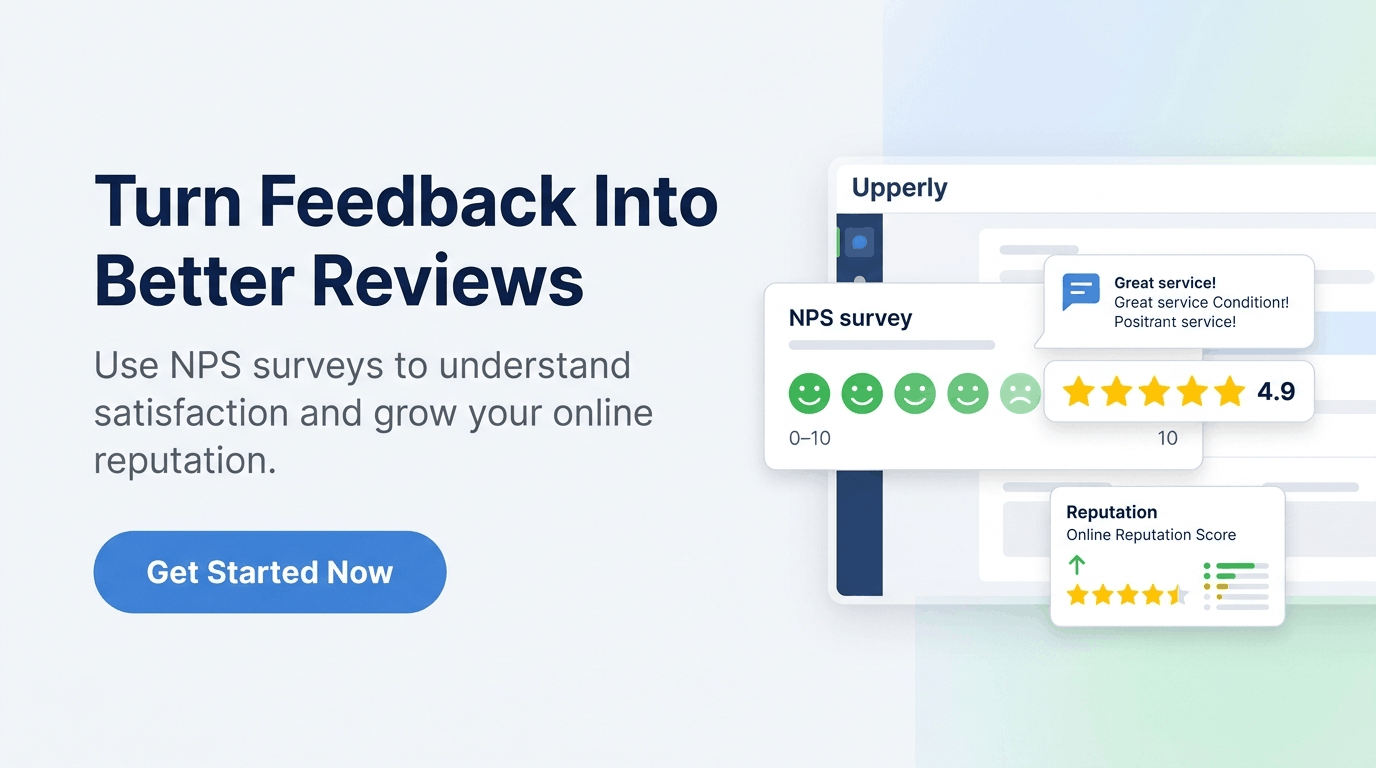
Effective NPS software does three things well: it collects feedback at the right moment, surfaces insights that are easy to act on, and connects those insights to the workflows your team already uses. A platform that delivers on all three will consistently outperform one with a longer feature list but poor day-to-day usability.
Define What You Actually Need Before Evaluating Any Tool
The most common mistake in any NPS software evaluation is starting with vendor demos before completing internal discovery. Before you open a single trial account, your team needs to agree on what problem you are actually solving. Is the priority capturing enough feedback volume to make the data statistically meaningful? Is it improving online review credibility on Google or the BBB? Is it understanding employee-level service performance? Without that clarity, every tool you evaluate will look equally capable, because you have not yet defined what “capable” means for your context.
Start by mapping your current feedback gaps honestly. Identify which customer touchpoints produce no structured feedback, where response rates are low, and where you lack the internal bandwidth to manage a complex setup. The answers will narrow your shortlist far more effectively than any vendor comparison chart.
Questions to Ask Before You Start a Trial
Work through these questions before committing to any trial period:
- How many customer interactions does your business handle per month, and what percentage receive any structured follow-up today?
- Does your team have someone available to configure, monitor, and act on feedback consistently, or does setup need to be handled externally?
- Which customer touchpoints matter most for retention: post-service, post-purchase, or ongoing relationship check-ins?
- Is your goal to improve internal service quality, build external review credibility, or both?
If the honest answer to the bandwidth question is that no one owns this function reliably, a done-for-you setup option deserves serious consideration from the start.
The Buying Criteria That Actually Predict Results
When it comes to criteria that genuinely correlate with outcomes, delivery mechanism ranks near the top. The channel and timing of survey delivery, whether contextual in-app triggers, post-transaction emails, or scheduled campaigns, significantly affects both response rates and data quality. Research cited by ProProfs Survey found that switching from an email-based survey blast to a contextual trigger caused NPS response rates to jump from 4% to 23%. That shift did not come from rewriting the question; it came from sending it at the right moment. This single factor should carry significant weight when you assess automation features during your platform evaluation.
Beyond delivery timing, look closely at reporting granularity. Aggregate NPS scores are useful for benchmarking, but they rarely drive action on their own. Research published by MeasuringU demonstrates that detecting meaningful score changes requires statistically sound methods, particularly when sample sizes are small or differences between time periods are subtle. A platform that presents trending scores without confidence intervals or significance indicators may be showing you noise rather than signal. The nps software features to compare go well beyond the survey builder itself; the analysis layer is where retention-relevant insight is actually generated.
Employee-level feedback granularity is another criterion that separates genuinely useful platforms from those that only capture blended, account-level sentiment. When feedback is tied to specific team members rather than the business as a whole, managers can identify exactly which service patterns are driving promoters and which are creating detractors. This visibility supports coaching, performance management, and process improvement in ways that a single aggregate score cannot.
| Criterion | What to Look For | Retention Outcome Supported |
|---|---|---|
| Delivery mechanism | Contextual triggers, not just scheduled blasts | Higher response rates; more timely feedback |
| Reporting granularity | Confidence intervals and significance indicators alongside scores | Distinguishes genuine loyalty shifts from noise |
| Employee-level granularity | Feedback attributed to specific team members or touchpoints | Enables targeted coaching and service improvement |
| Pricing flexibility | Pay-as-you-go option available | Scales investment in proportion to results |
| CASL compliance | Opt-in management, unsubscribe handling, consent records | Protects sending reputation and customer trust |
| Data ownership | Full export capability if you switch platforms | Preserves historical data for longitudinal analysis |
| Setup support | Done-for-you option when internal capacity is limited | Ensures consistent deployment and follow-up |

How to Approach Pricing Without Overcommitting Early
Pricing structure deserves early attention, not an afterthought. Many platforms default to annual subscription models that lock your team into a fixed cost before you have validated whether the tool fits your customer base, your internal processes, or your actual send volume. For teams testing NPS for the first time or scaling gradually, that commitment creates financial pressure to justify the platform even when results are mixed.
A pay-as-you-go model removes that pressure. It allows you to start with a realistic email volume, measure actual response rates and outcome impact, and scale your investment based on evidence rather than optimism. This is particularly relevant when thinking about how to compare nps tools for small teams, where budget flexibility matters as much as feature depth. Starting at a lower volume tier also gives you time to refine your survey timing, messaging, and follow-up workflow before committing to higher send frequencies.
Matching Send Volume to Platform Fit
Before comparing cost models, estimate your realistic monthly send volume. Take your total number of active customers or monthly transactions and apply a conservative response rate assumption. If your list is 500 contacts and you anticipate a 15% response rate, you are working with roughly 75 responses per cycle. That volume is enough to identify trends and act on detractor feedback, but it does not justify a high-tier subscription designed for enterprise send volumes. Matching your estimated volume to a platform’s pricing tiers early in the process prevents you from paying for capacity you will not use.
| Factor | Pay-as-You-Go | Annual Subscription |
|---|---|---|
| Upfront commitment | Low — pay based on actual usage | High — fixed cost locked in for a year |
| Financial risk | Low — easy to scale back if results are mixed | Medium to high — cost persists regardless of outcomes |
| Best suited for | Teams new to NPS or with variable send volumes | Teams with high, consistent send volumes |
| Per-unit cost | Typically higher at low volumes | Typically lower at high volumes |
| Flexibility to switch | High — no long-term lock-in | Low — notice periods and contract terms may apply |
| Validation before scaling | Supported — scale based on evidence | Limited — commitment precedes validation |
What Vancouver Businesses Should Verify Before Committing
Due diligence should go beyond reading feature documentation. For Canadian businesses, CASL compliance is a non-negotiable requirement. Any platform that sends commercial electronic messages on your behalf must support opt-in management, unsubscribe handling, and consent record-keeping in a way that aligns with Canada’s Anti-Spam Legislation. If a vendor cannot confirm how they support CASL compliance specifically, that is a material gap, not a minor detail. This applies whether your customers are in Metro Vancouver, the Fraser Valley, or elsewhere across BC.
Data ownership terms are equally important. Confirm explicitly that your customer data, response records, and historical feedback belong to you and can be exported in a usable format if you switch platforms. Some tools that appear affordable upfront include contract conditions that complicate data portability or require extended notice periods to cancel. The nps software implementation checklist for any serious evaluation should also confirm that the tool connects cleanly with your CRM, email system, or review management process, because a disconnected feedback loop is almost as unhelpful as no feedback at all.

When to Get Help Setting Up Rather Than Going It Alone
Self-managed NPS tools work well when a CX manager has the time, technical confidence, and internal support to configure and maintain them properly. In practice, many teams in Vancouver operate without a dedicated CX operations function, which means setup tasks compete with daily client management, team oversight, and everything else on a manager’s plate. When that is the reality, the honest recommendation is to explore a done-for-you setup option rather than assuming self-configuration will happen consistently.
Understanding how nps integrates with customer workflows is where many well-intentioned implementations fall apart. A simple tool that is fully configured, reliably deployed, and consistently reviewed will outperform a feature-rich platform that sits half-finished in a back-end account. The sophistication of the software matters far less than whether it is actually generating feedback that your team reads and acts on.
Key Criteria When Choosing NPS Software
Use this summary as a practical checklist when comparing your shortlisted platforms:
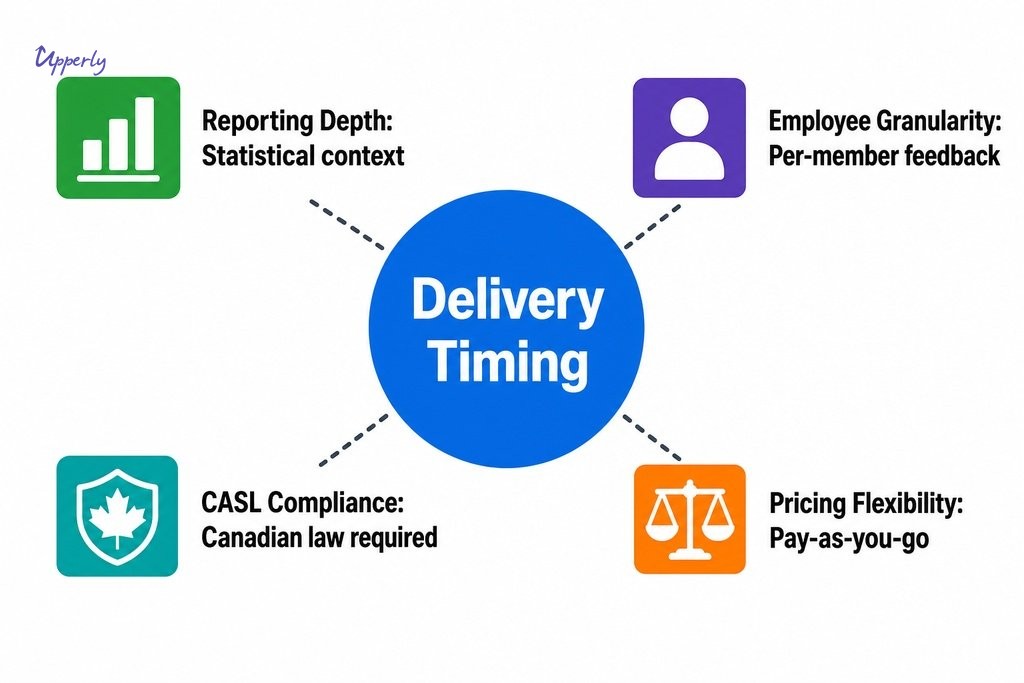
- Delivery mechanism: Does the platform support contextual triggers, not just scheduled email blasts?
- Reporting depth: Are score changes presented with statistical context, or just raw averages?
- Employee-level granularity: Can feedback be attributed to specific team members or service touchpoints?
- Pricing flexibility: Is a pay-as-you-go option available, or is annual commitment required upfront?
- CASL compliance: Does the vendor explicitly support opt-in management and Canadian consent requirements?
- Data ownership: Can you export all your data cleanly if you switch platforms?
- Setup support: Is a done-for-you option available if your team lacks dedicated CX operations capacity?
Connecting Your Platform Decision to Retention Outcomes
Every criterion in this framework maps to a specific business result. Automation reliability drives higher response rates. Statistically sound reporting helps you distinguish genuine loyalty shifts from score fluctuations caused by a single difficult week. Employee-level granularity gives frontline managers the context they need to coach service quality in real time. CASL-compliant delivery protects your sending reputation and customer trust. Flexible pricing allows you to scale your programme in proportion to what it is actually producing.
It is also worth recognising that NPS benchmarks are not static. Temkin Group research found that 15 out of 20 industries showed a decrease in average NPS score over a three-year study period, suggesting that holding steady in a declining market may itself represent a meaningful retention outcome. Your software needs to support that kind of longitudinal context rather than presenting scores as isolated data points without industry or time-period reference.
The right NPS tool is not a reporting dashboard you check occasionally. It is an operational input that shapes how your team identifies at-risk customers, responds to service failures, builds review credibility on platforms like Google and the BBB, and earns the kind of loyalty that reduces churn over time. If you are ready to build that kind of feedback programme for your Vancouver business, Upperly’s platform is designed to make it straightforward, from flexible pay-as-you-go packages to full-service setup support. Reach out to explore which option fits your team best.
Frequently Asked Questions About NPS Software
What is NPS software and how does it work?
NPS software automates the process of sending Net Promoter Score surveys to customers and collecting their responses. It delivers a single scored question alongside an open-text follow-up, then aggregates results into dashboards that help CX teams track sentiment, identify at-risk customers, and measure loyalty over time.
How is NPS software different from a general survey tool?
NPS software is purpose-built around the 0–10 promoter score question, with reporting designed to surface detractor trends, segment responses by score category, and track loyalty shifts over time. General survey tools can replicate the question format but rarely include the longitudinal benchmarking or workflow integrations that make NPS data actionable for retention.
What should Canadian businesses look for in NPS software for CASL compliance?
Look for a platform that manages opt-in consent, handles unsubscribe requests automatically, and maintains consent records as required by Canada’s Anti-Spam Legislation. Confirm that the vendor explicitly supports these requirements before committing, as a gap here carries legal and reputational risk, not just a missing feature.
How many responses do you need for NPS data to be reliable?
There is no universal threshold, but statistically meaningful trends typically require more than a handful of responses per reporting period. Research from MeasuringU highlights that small sample sizes make it difficult to distinguish genuine score changes from random variation, so factor in your expected response rate before selecting a platform tier.
Is a pay-as-you-go NPS plan better than an annual subscription?
For teams new to NPS or those with variable send volumes, pay-as-you-go reduces financial risk and lets you scale based on actual results. Annual subscriptions can offer better per-unit value at high volumes, but committing before validating platform fit often creates pressure to justify the cost regardless of outcomes.
When does it make sense to use a done-for-you NPS setup?
A managed setup makes sense when no one on your team has dedicated time to configure, monitor, and maintain the programme consistently. A simple, fully configured tool that runs reliably will generate more useful feedback than a sophisticated platform that never gets properly deployed.
Social Share


How Review Request Campaigns Work and Drive Real Results
Key Takeaways A structured review request campaign automates the process of collecting customer reviews, driving measurable gains in volume, local search visibility, and brand…


Strategies to Improve Customer Retention
Customer retention is the most important issue for all companies. If you want your business always to be successful, you should pay a lot of…

How to Choose Review Management Tools That Drive Results
Key Takeaways Upperly outlines a practical, goal-first framework to help Vancouver marketing teams choose review management tools that deliver measurable results. Start by auditing your…

Smart Questions to Ask Before Buying Review Software
Key Takeaways Ask the right questions about data ownership, pricing, automation, and integrations before committing to any review software platform. Every question you bring into…