

 Home
HomeSmart Questions to Ask Before Buying Review Software
 Category:Articles
 July 6, 2026 / AT: 5:05 PM
 173 View
 No Comment
Key Takeaways
Ask the right questions about data ownership, pricing, automation, and integrations before committing to any review software platform.
- Every question you bring into a vendor demo should connect to a specific decision about pricing, data ownership, or integration compatibility rather than general feature curiosity.
- Ask vendors who owns your review data after collection and whether you can export it in a portable format if you switch platforms; this protects your business from lock-in and supports Canadian privacy compliance.
- For seasonal or variable campaigns, a pay as you go pricing model is often more practical than a fixed monthly subscription because you only pay for actual usage.
- Request a live walkthrough of reporting filters, onboarding steps, and support escalation rather than accepting a pre-recorded demo; real time walkthroughs reveal whether vendor processes are mature or improvised.
- Employee level feedback attribution is not a universal feature; confirm whether the platform can tie reviews and survey responses to individual team members to connect customer experience data to staff performance.
Choosing a review management platform looks straightforward until you are three months into a contract and realising the tool does not fit how your team actually works. The questions to ask before buying review software are not just a formality. They are how you separate platforms that genuinely support your goals from those that simply look polished in a demo. For marketing and growth teams in Vancouver, where competition for customer attention is real and online reputation carries measurable weight across neighbourhoods from Mount Pleasant to the North Shore, this evaluation deserves more rigour than a quick slide-deck review.
This guide helps you ask better questions at every stage of the buying process, from your first vendor conversation through to final commitment. It is designed around the practical context of Canadian businesses comparing reputation management solutions. Understanding how to choose review management tools starts long before you open a pricing page.
Why the Right Questions Matter More Than the Demo
Most vendors lead with features because features are easy to demonstrate and easy to make look impressive. A polished demo tells you what the software can do under ideal conditions, not whether it will integrate with your customer communication flow or hold up when campaign volume spikes.
Research from Harvard Business Review suggests that unreliable evaluation outcomes often trace back to the quality of the questions being asked, not the platform being assessed. Poor question wording produces incomplete vendor responses, leaving buyers with a false sense of confidence after a demo.
The Qualaroo editorial team, citing established market research principles, put it plainly: “Every question must map to exactly one decision. If you cannot name the decision, the question does not belong in the survey.” That principle applies directly to vendor evaluations. Every question you bring into a demo should connect to a specific decision about pricing, data ownership, or integration compatibility. A buyer’s guide from the Customer Solution Center recommends a minimum of 56 structured evaluation questions for any serious software partnership, underscoring that a short checklist is not enough when your business reputation is on the line.
Questions About Review Collection and Automation
The core function of any review platform is gathering feedback at the right moment, through the right channel, with the right message. Before committing, ask specifically how the platform sends review requests:
- Can you control timing relative to a purchase or service interaction?
- Is email content customisable, or are you locked into a template?
- Can automation settings be adjusted per campaign rather than applied as a single global configuration?
These details determine whether the platform fits naturally into your existing workflows or whether your team has to work around it. Also ask how the platform handles customers who do not respond to the first request. Does it support follow-up sequences, and can those sequences be adjusted per location or per team? Automated email sequencing that aligns with your communication calendar is a key differentiator between tools built for genuine business use and those built purely to inflate review volume without context.
Does the Platform Attribute Feedback to Individual Employees?
For service businesses, feedback tied to a specific team member is often more actionable than aggregate scores. Ask whether the platform can attribute reviews and survey responses to individual employees, not just the business as a whole. Platforms that offer employee-level granularity give marketing and operations teams a shared data layer that connects customer experience to staff performance. Confirm how that attribution works in practice and whether it can be filtered in reporting dashboards.
| Category | What to Ask | Why It Matters |
|---|---|---|
| Request Timing | Can timing be controlled per purchase or service interaction? | Ensures requests reach customers at the most relevant moment |
| Email Customisation | Is content fully customisable, or template-locked? | Affects whether messaging fits your brand voice |
| Automation Flexibility | Can settings be adjusted per campaign or location? | Prevents a one-size-fits-all approach from limiting campaigns |
| Follow-up Sequences | Does the platform support multi-step follow-up? | Improves response rates without manual intervention |
| Employee Attribution | Can reviews be tied to individual team members? | Connects customer experience data to staff performance |
Review Platform Demo Questions Worth Asking Every Vendor
A demo is your best opportunity to stress-test a vendor’s claims. Come prepared with specific questions rather than letting the vendor control the entire conversation:
- How is review data reported, not just collected?
- Can you filter results by employee, by location, or by timeframe?
- What does the dashboard look like after three months of active use, not just after setup?
- Can you walk me through NPS survey tools and automated email sequencing live, not via a pre-recorded presentation?
Live walkthroughs reveal friction points that curated demos do not. ECI Software Solutions notes in their evaluation guidance that “asking ‘What is the process’ suggests to a vendor that does not have a process in place that this is a requirement for business.” When you ask vendors to walk through onboarding, support escalation, and data reporting step by step, you quickly learn whether those processes are mature and documented or improvised on the spot. Vendors with strong operational foundations answer these questions without hesitation.

Pricing Models and Commitment: What to Clarify Upfront
Pricing questions are often the most uncomfortable to raise but among the most important. Start by clarifying these points:
- Is a subscription mandatory, or can you pay for the specific volume you need?
- What are the tier thresholds, and what changes when you move between tiers?
- Are there additional fees for onboarding, technical support, or specific integrations?
The Canadian Federation of Independent Business recommends that Canadian business owners clarify exactly what is included in any quoted price before signing, particularly for software with tiered packaging. For Vancouver businesses with seasonal campaigns, whether tied to summer tourism, the holiday retail period, or local events, a pay-as-you-go model is often more cost-effective than a fixed monthly subscription. Understanding how to evaluate review software pricing means going beyond the headline number and asking what happens to unused capacity, whether there are rollover provisions, and what the cancellation process looks like.
| Factor | Fixed Monthly Subscription | Pay-As-You-Go |
|---|---|---|
| Cost predictability | High — same fee each billing cycle | Varies with usage volume |
| Fit for seasonal campaigns | Lower — you pay full rate during quiet periods | Higher — spend scales with actual campaign activity |
| Unused capacity | Often lost; rollover depends on vendor terms | Only pay for what you use |
| Commitment risk | Higher — tied to contract length | Lower — flexibility to adjust or cancel |
| Best suited for | Teams with consistent, high review volume | Businesses with variable or seasonal demand |
Data Ownership, Privacy, and Platform Accountability for Vancouver Businesses
Canadian businesses carry a specific responsibility in this area. Under Canadian privacy legislation, businesses handling customer contact information are accountable for how that data is collected, stored, and used, even when a third-party platform is doing the processing. Ask every vendor directly:
- Who owns the review data after it is collected?
- Can you export it in a portable format if you switch platforms?
- How is customer contact information stored, and where are the servers located?
Statistics Canada advises that buyers of any data-generating platform should assess the methodology behind the data it produces: “You should question what a statistic represents, how it was calculated, and its strengths and limitations.” That guidance applies equally to the review and NPS data a platform generates on your behalf. Ask vendors to document their data quality controls, explain how they verify that reviews are authentic, and confirm what happens to your data if you stop using the service. Platforms that cannot answer these questions transparently introduce privacy and compliance risk into your operations.

Evaluating Ease of Use and Setup Support
A platform your team does not use consistently delivers no value. Before committing, ask these practical questions:
- Does setup require developer involvement, or can a non-technical team member handle it?
- Is there a done-for-you setup option for teams that cannot afford a lengthy onboarding period?
- Does the platform offer self-serve documentation and a live support channel?
These review tool decision factors are often overlooked when buyers are focused on feature lists. If the answer to “how long does setup take?” is measured in weeks and involves multiple onboarding calls, weigh that carefully against your team’s capacity. Platforms built with simplicity as a design principle tend to see higher adoption rates and faster time-to-value.
How to Make a Confident Final Decision
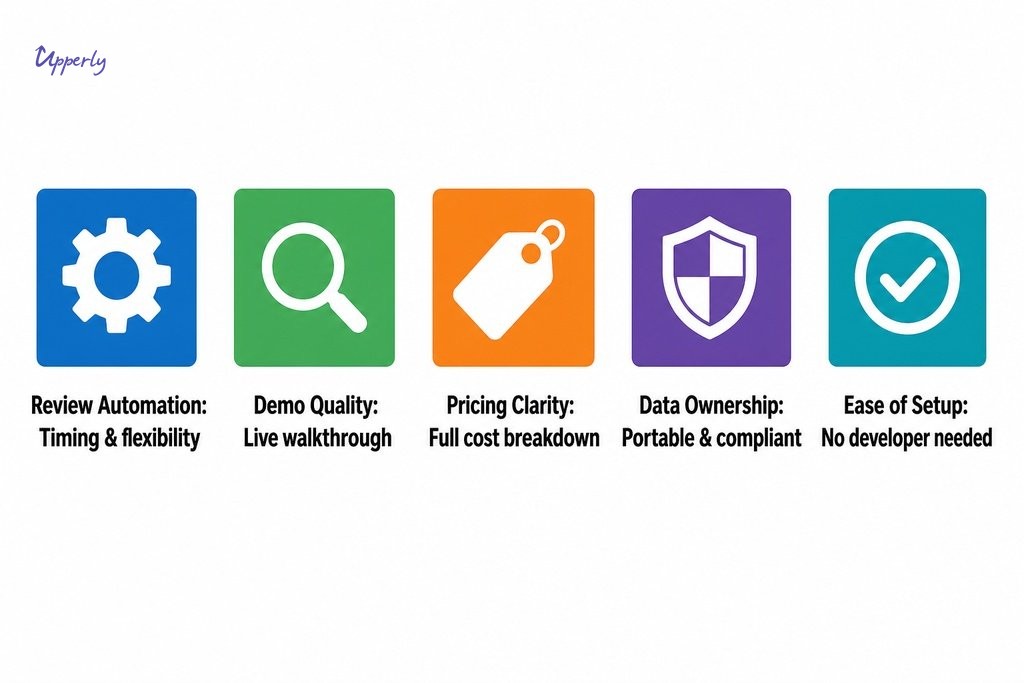
Once you have worked through questions on collection, automation, pricing, data ownership, and usability, you will have a clearer picture of which vendors are a genuine fit and which are offering surface-level solutions dressed up in good design. The questions that separate the two ask for specifics rather than general reassurances: show me the reporting, walk me through the process, tell me what happens to my data.
The Canadian approach to software buying, as reflected in guidance from the CFIB, consistently emphasises understanding what you are actually getting rather than what is being promised. Before finalising your decision, request a trial volume or a small-scale pilot. A supported trial period lets you validate vendor claims with your own data before committing your full campaign budget.
As you scale, confirm the platform can handle increasing email volume, additional employee profiles, and evolving campaign structures without forcing a disruptive migration. Understanding how to evaluate review software integrations with your CRM, booking system, or email platform is worth its own careful assessment, and is covered separately within this resource.
Upperly is built for exactly this kind of evaluation. With flexible packages, no mandatory subscription, employee-level feedback attribution, and a done-for-you setup option, it is designed to meet the needs of Canadian marketing teams, including growing businesses across Metro Vancouver, who want results without complexity. If you are ready to ask the right questions of a platform that can answer them clearly, reach out to the Upperly team and start the conversation.
Frequently Asked Questions
What is the most important question to ask a review software vendor before buying?
Ask who owns the review data after it is collected and whether you can export it if you switch platforms. Data portability protects your business from vendor lock-in and supports compliance with Canadian privacy obligations.
Should review software require a long-term subscription commitment?
Not necessarily. Many platforms offer flexible or pay-as-you-go models that suit businesses with seasonal or variable review volume. Before signing, clarify tier thresholds, cancellation terms, and whether unused capacity rolls over.
How can I tell whether a vendor’s demo reflects real-world performance?
Ask for a live walkthrough of specific workflows rather than a pre-recorded presentation. Having the vendor demonstrate reporting filters, onboarding steps, and support escalation in real time quickly reveals whether those capabilities are polished or improvised.
Does review software need to comply with Canadian privacy law?
Yes. Any platform processing customer contact information on your behalf must align with Canadian privacy legislation, and your business remains accountable for that data. Ask vendors where servers are located, how data is stored, and what happens to customer information if you cancel.
How do I evaluate review software pricing beyond the headline cost?
Ask about onboarding charges, integration fees, tier limits, and cancellation terms. Understanding how to evaluate review software pricing means mapping the full cost against your actual usage patterns, not just the advertised rate.
Is employee-level feedback attribution a standard feature in review platforms?
It is not universal. Some platforms report only at the business level, while others allow you to attribute reviews and survey responses to individual employees. For service-based businesses, this granularity is particularly valuable for connecting customer experience data to staff performance.
Social Share


Increase your Google organic stars
The best way that you can get more organic stars is that ask from your costumers. Make customers conscious that they can review and star…


Remove negative google reviews
Customers have different perceptions of products and services. Because of different experiences, we can see positive or negative google reviews. Of course, positive feedback will…

How to grow positive google review?
It's important for all businesses to get positive google review through customers. Getting positive google review brings a lot of business benefits, which is most…

Why Customers Leave Negative Reviews and How to Close the Gaps
Key Takeaways Negative reviews follow predictable patterns of unmet expectations and service gaps that businesses can intercept before dissatisfaction goes public. Most negative reviews stem…