

 Home
HomeReview Analytics Features That Move the Needle

 Category:Articles
 June 30, 2026 / AT: 1:35 PM
 301 View
 No Comment
Key Takeaways
Upperly helps marketing and growth teams identify the review analytics features that matter most for improving retention, trust signals, and conversion outcomes.
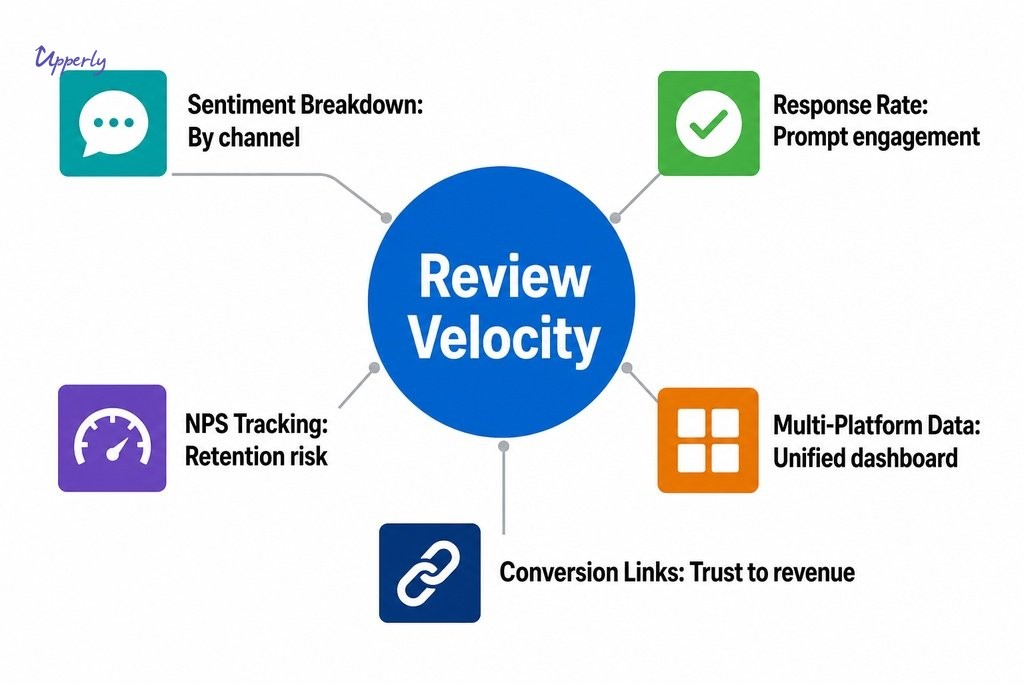
- Focus your weekly review dashboard on three to five high signal metrics such as review velocity, response rate, and net new reviews by platform rather than tracking every available number.
- Sentiment breakdown by theme across Google, Facebook, and Yelp surfaces patterns that aggregate star ratings hide, giving teams the specificity needed to address operational gaps early.
- Review velocity and recency directly influence search rankings and buyer confidence, making them leading indicators of campaign performance worth monitoring in real time.
- Customer feedback analytics become a retention tool when tied to individual employee performance and NPS data, allowing managers to act on friction points before customers disengage.
- Before committing to any reputation analytics platform, verify data ownership, platform integrations, and sentiment calculation methods through a trial period rather than relying on feature lists alone.
Not all analytics are created equal, and nowhere is this more apparent than in online reputation management. Marketing and growth teams across Vancouver, from Gastown and Mount Pleasant to the North Shore and South Surrey, are increasingly focused on identifying the analytics features that support smarter decisions about customer retention, trust-building, and conversion strategy. Yet many platforms leave teams swimming in data that looks comprehensive on screen but contributes very little to outcomes that actually count. The difference between useful intelligence and visual noise comes down to which metrics you track and why.
This article walks through the review analytics features that deserve your attention, how to interpret them in context, and what to look for when evaluating reputation analytics tools that fit the way your team actually works.
Why Most Review Dashboards Show You Everything Except What Matters
The appeal of a feature-rich dashboard is easy to understand. When a platform displays dozens of metrics, it signals depth and sophistication. The problem is that volume of data does not equal clarity of direction. Many reputation analytics tools are built to impress during demos rather than to support weekly decisions by real marketing teams. When every number looks equally important, none of them guides action.
A dashboard that tracks review volume, average star rating, sentiment breakdown, response rate, and platform distribution across a single screen is genuinely useful. One that adds thirty more widgets without connecting any of them to retention or conversion goals creates distraction, not insight. Growth-focused teams should approach their review reporting with one clear question: does this metric help us make a better decision this week?

Which Review Analytics Features Actually Matter
The features that matter most are those tied directly to your business outcomes. Sentiment trends, review velocity, response rate tracking, and platform-level performance connect most directly to trust signal strength and conversion lift. Multi-platform visibility matters as much as depth within any single channel, since combining data sources tends to produce more reliable insights than relying on one metric alone.
Sentiment analysis and theme-based categorization are widely recognised methods for extracting structured insights from unstructured customer feedback. For marketing teams, this means moving beyond star ratings to understand what customers are actually saying about specific aspects of their experience. Research published in the Journal of Business Research (ScienceDirect) confirms that machine learning applied to online customer reviews can reveal actionable patterns that inform marketing strategy, and that level of analytical sophistication is increasingly accessible within modern reputation platforms.
Review Velocity and Recency Signals
Review velocity is how frequently new reviews arrive over a given period. Review recency is how recently those reviews were posted. Both signals influence search visibility and buyer confidence.
Search algorithms on platforms like Google weight recency heavily. A business with fifty older reviews may rank lower than a competitor with thirty recent ones. For buyers in competitive local markets like Vancouver, a string of reviews posted within the last thirty days signals an active, trusted business. A last review from eighteen months ago raises questions about whether things are still running smoothly.
Growth teams should monitor velocity as a leading indicator of campaign performance. If a review collection campaign is running but velocity is flat or declining, investigate deliverability, timing, or targeting before the downstream impact on search rankings becomes visible.
Sentiment Breakdown Across Channels
Tracking positive, neutral, and negative sentiment over time, across Google, Facebook, Yelp, and similar platforms, reveals patterns that aggregate star ratings will never surface on their own. A business might maintain a 4.2-star average while quietly accumulating negative sentiment around a specific service line or employee interaction. Without channel-level sentiment tracking, that pattern stays invisible until it becomes a larger reputation issue.
Sentiment tracked by theme, such as wait times, communication quality, or value for money, gives marketing teams the specificity they need to adjust messaging and address operational gaps before they compound.
Review Dashboard Metrics Worth Monitoring Week Over Week
Not every metric in your review dashboard deserves weekly attention. Some numbers are better suited to monthly strategic reviews, while others are pure vanity. The metrics that belong in your weekly routine are those that change frequently and respond to actions your team can take immediately:
- Review velocity: Are new reviews arriving at a consistent or improving rate?
- Response rate: Are you engaging with reviewers promptly across platforms?
- Net new reviews by platform: Where is review activity growing or stalling?
Average rating, while important, moves slowly and is better assessed monthly alongside sentiment trend data. Dashboard fatigue is a real problem for marketing teams managing multiple channels. Keeping the weekly view focused on three to five high-signal metrics prevents the kind of analysis paralysis that leads teams to stop checking dashboards altogether. The discipline of focusing on fewer, better metrics separates teams that act on their data from those who simply collect it.
| Metric | Review Frequency | What It Tells You |
|---|---|---|
| Review velocity | Weekly | Whether new reviews are arriving at a consistent or improving rate |
| Response rate | Weekly | Whether your team is engaging with reviewers promptly across platforms |
| Net new reviews by platform | Weekly | Where review activity is growing or stalling across channels |
| Average star rating | Monthly | Overall satisfaction trend over a longer period |
| Sentiment trend data | Monthly | Shifts in positive, neutral, or negative tone across platforms |

Using Customer Feedback Analytics to Strengthen Retention
Customer feedback analytics supports retention by identifying at-risk customers before they decide to leave. NPS (Net Promoter Score) survey data is particularly valuable here. It captures satisfaction signals at a point when intervention is still possible. A customer who gives a score of six out of ten has not yet churned, but their feedback can tell you where friction exists and what would need to change to earn their loyalty.
For service businesses in Vancouver, whether in home services, professional trades, healthcare, or hospitality, employee-specific feedback adds another layer of precision. When feedback is tied to individual team members rather than the business as a whole, managers can identify performance patterns that aggregate scores hide. A technician, account manager, or front-line staff member who consistently receives lower sentiment scores represents a retention risk that is worth addressing early, since doing so has a direct effect on whether customers return.
Upperly’s employee-level feedback feature was built specifically for this use case, giving service businesses the granularity they need to act on feedback rather than simply receive it.
What Review Reporting Features Should Tell You About Campaign Performance
Review reporting features become genuinely useful when they are tied directly to the campaigns generating those reviews. A strong reporting layer should answer how many review requests were sent, how many resulted in a published review, which platforms received the most activity, and what the sentiment distribution looks like across that cohort. Without that connection between campaign action and review outcome, you are measuring results without understanding what produced them. These are among the important features in review management software that too many platforms treat as secondary. Volume without quality is not a win.
Connecting Review Performance Metrics to Real Conversion Data
The most advanced use of review performance metrics involves linking review activity to actual conversion outcomes. When review volume increases on Google, do inquiry rates on your website follow? When average rating climbs on a specific platform, does that correlate with more first-time customers mentioning that platform? These connections are not always linear, but tracking them over time builds a clearer picture of where trust signals are doing the most work in your conversion funnel.
Research published in PMC (National Center for Biotechnology Information) highlights how advanced analytics and machine learning enable automated, intelligent decision-making from both structured and unstructured data, a principle that applies directly to interpreting how review signals translate into measurable business results.

Choosing Reputation Analytics Tools That Fit Vancouver Businesses
The best reputation analytics tools are the ones your team will actually use consistently. Ease of use, clear onboarding, and logical dashboard design matter as much as feature depth, especially for marketing teams without dedicated operations support. A platform that requires significant configuration before delivering any value will sit unused after the first month, regardless of how sophisticated its analytics appear on paper.
Practical evaluation criteria should include how quickly the platform integrates with your existing review channels, whether reporting can be customised to match your team’s workflow, and whether pricing is flexible enough to scale without locking you into a subscription that no longer fits. Upperly addresses this directly with a pay-as-you-go model that starts at accessible price points, alongside a done-for-you setup option for teams that want the capability without the configuration overhead.
What to Verify Before Committing to a Review Analytics Platform
Before adopting any review analytics solution, there are practical questions worth asking that go beyond the feature checklist. Data ownership is one of the first: does your business retain ownership of the reviews and feedback data collected through the platform, or does the vendor hold it? Platform integrations matter equally. Can the tool connect to Google, Facebook, and Yelp? A reporting layer that misses key channels produces an incomplete picture of your reputation footprint.
Methodological transparency is equally important. How are sentiment scores calculated? Is NPS data benchmarked against industry norms? How does the platform handle disputed or removed reviews in its reporting? These are also the moments to revisit the review request automation features to look for in any platform you are considering, since the quality of incoming reviews depends heavily on how those requests are sent and to whom.
| Evaluation Factor | What to Ask |
|---|---|
| Data ownership | Does your business retain ownership of all reviews and feedback data? |
| Platform integrations | Does the tool connect to Google, Facebook, Yelp, and other key channels? |
| Sentiment scoring methodology | How are sentiment scores calculated and how transparent is the process? |
| NPS benchmarking | Is NPS data benchmarked against industry norms? |
| Disputed review handling | How does the platform treat removed or disputed reviews in its reporting? |
| Pricing flexibility | Can pricing scale with your business without locking you into a fixed subscription? |
| Trial or sample access | Can you validate analytics usability before committing to the platform? |
Above all, validate any platform’s claims with a trial period or sample dataset before committing. Feature lists are marketing materials. Actual usage tells you whether the analytics features that matter to your team are genuinely accessible in practice.
If you are ready to build a review analytics strategy that connects directly to growth and retention outcomes, Upperly is designed to make that process straightforward for businesses of any size across Vancouver and the Lower Mainland. Reach out to explore how the platform can support your team’s specific goals and reporting needs.
Frequently Asked Questions About Review Analytics Features
- What is the difference between review velocity and average star rating?
- Review velocity measures how frequently new reviews are posted over a set period, while average star rating reflects overall satisfaction across all reviews to date. Velocity is a more dynamic signal that responds quickly to campaigns and seasonal changes, making it more useful for week-over-week performance tracking than a slowly moving average rating.
- How do reputation analytics tools handle reviews from multiple platforms?
- Most reputable analytics tools aggregate review data from platforms like Google, Facebook, and Yelp into a unified dashboard. This lets teams compare performance across channels, identify where sentiment differs, and prioritise response efforts. Not all tools support every platform equally, so confirming integration coverage before committing is important.
- What is NPS and why does it matter for retention analytics?
- NPS, or Net Promoter Score, measures how likely customers are to recommend your business on a scale of zero to ten. Scores below seven can indicate dissatisfaction that has not yet appeared in public reviews. Tracking NPS alongside review sentiment gives service teams an earlier view of retention risk before customers disengage or leave negative public feedback.
- How often should a growth team review their reputation dashboard?
- High-frequency metrics like review velocity, response rate, and net new reviews by platform are worth checking weekly since they respond quickly to team actions. Average rating and sentiment trend data are better suited to monthly reviews, assessed alongside broader marketing or campaign performance data.
- What should businesses look for in a review analytics platform before signing up?
- Key considerations include data ownership, platform integrations, sentiment scoring methodology, and pricing flexibility. A trial period or sample dataset is the most reliable way to assess whether the platform’s analytics are genuinely accessible in day-to-day use, rather than impressive only during a sales demonstration.
Social Share



Smart Questions to Ask Before Buying Review Software
Key Takeaways Ask the right questions about data ownership, pricing, automation, and integrations before committing to any review software platform. Every question you bring into…


Why Private Feedback Should Come Before Public Reviews
Key Takeaways Collecting private customer feedback before requesting public reviews lets businesses intercept dissatisfaction early, protect their reputation, and grow credible reviews with intention. Sending…

How to Get More Reviews on Google?
Nearly 90 percent of people trust online reviews, and, and this gives small businesses the opportunity to attract new business via the Internet. Google review…

why online reputation is important?
Online reputation refers to impressing and bridling of an individual's or group's reputation. Generally, it helps all kind of business that they can get the…