

 Home
HomeReview Management Software Features That Drive Real Results
 Category:Articles
 June 26, 2026 / AT: 9:20 AM
 301 View
 No Comment
Key Takeaways
Upperly breaks down the review management software features that actually drive measurable results for Canadian marketing and growth teams.
- Focus on outcome-relevant features rather than feature volume; a platform with ten capabilities your team uses daily outperforms one with fifty capabilities that go unused.
- Automated review request sequences with timing controls, channel selection, and message personalisation are the highest-impact features for growing review volume consistently.
- Real-time multi-platform monitoring across Google, Facebook, Yelp, and the BBB gives your team the speed needed to respond before negative sentiment causes lasting damage.
- NPS survey tools combined with employee-level feedback collection provide actionable customer insight that goes well beyond star ratings and supports internal accountability.
- Review analytics with trend tracking and campaign-level reporting transform reputation management from a soft initiative into a demonstrable business driver for leadership reporting.
When your team sits down to evaluate review management software, the sheer number of features on vendor comparison pages can make the process feel more confusing than clarifying. The features that actually matter are not always the ones given the most screen space in product brochures. What counts is whether a feature connects directly to a measurable business outcome: a higher average rating, faster response to negative feedback, or more completed review requests.
This guide is built for marketing and growth teams in Vancouver and across Canada who want to cut through the noise and focus on capabilities that move the needle. According to Harvard Business School research, businesses may see revenue improvements of 5 to 9 percent with a one-star rating increase, though results will vary by industry and market. That framing reframes the entire conversation: the features worth paying for are the ones that help you earn and protect those stars consistently over time.
Understanding how to choose review management tools starts with shifting your focus away from feature volume and toward feature relevance.
Why Long Feature Lists Miss the Point
Most review software comparison pages are designed to impress rather than inform. They stack capability after capability into long horizontal tables, creating the impression that more columns equal more value. For lean marketing teams, this approach obscures what actually drives results.
A feature that sounds impressive in a table but requires a dedicated administrator to configure is not a feature your team will ever fully benefit from. The real question during any evaluation is not “does this platform offer it” but rather “will our team actually use it, and will it produce a measurable outcome.”
When you apply this lens to review software, the short list of genuinely important features becomes much easier to build. The sections below work through the most outcome-relevant capabilities in sequence, so your team can build an evaluation framework grounded in results rather than feature counts.
Review Request Automation: The Highest-Impact Feature Category
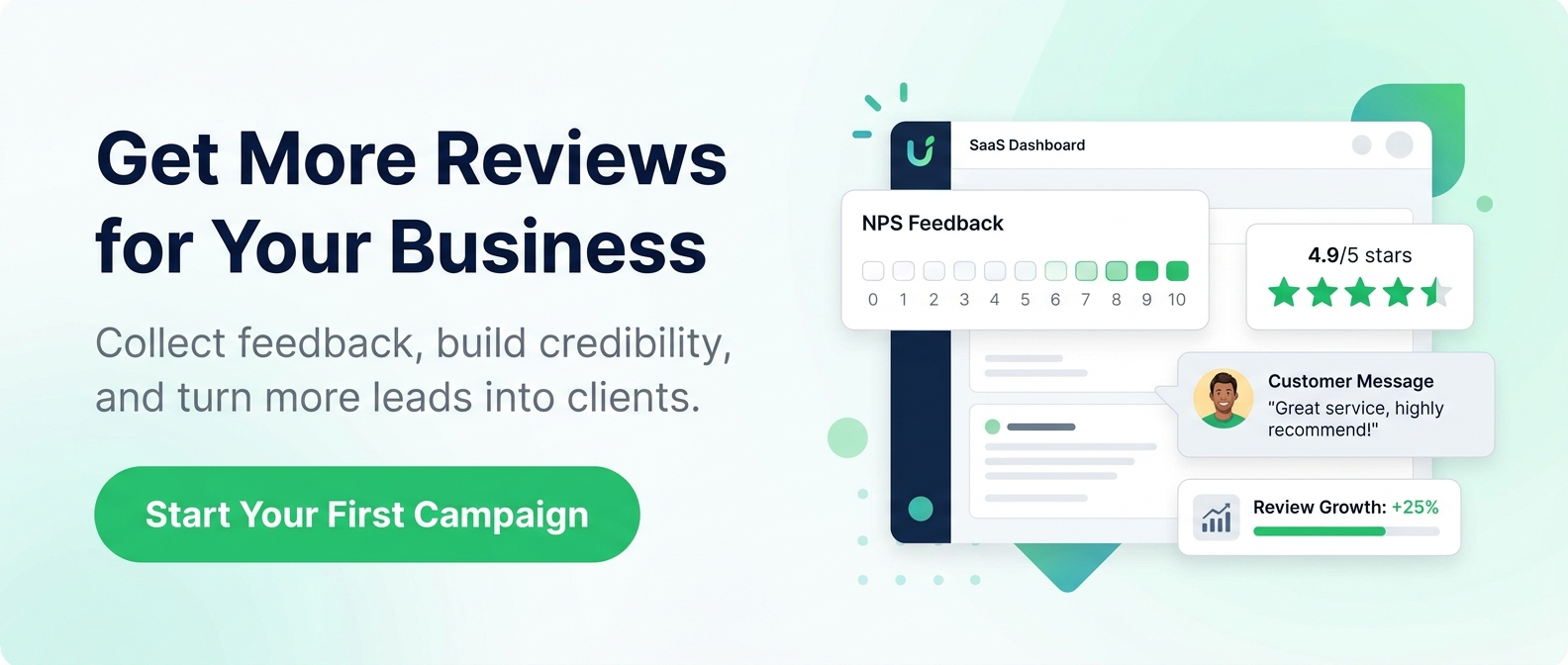
For most businesses, automated review collection delivers the greatest return. The review request automation features to look for are timing controls, channel selection, and message personalisation. Without these three elements working together, even a high send volume will produce disappointing response rates. A generic message sent at the wrong time is easy to ignore.
Automated follow-up sequences are equally important and often undervalued. A single review request email will only convert a fraction of recipients. A well-timed follow-up, sent only to those who did not respond, can meaningfully lift that number without adding manual effort. The ability to configure the interval between messages and the number of follow-up attempts gives your team control over the process without increasing workload.
Automation That Fits How Vancouver Teams Actually Operate
One practical friction point many teams encounter is being locked into a subscription tier that does not match their actual send volume. A seasonal business on the North Shore, a growing startup in East Vancouver, or a team running targeted campaigns at irregular intervals should not be forced into a monthly commitment sized for consistent high-volume sending.
Pay-as-you-go email volume models give lean teams far more control over cost and scalability. Upperly is built around exactly this model, with email packages starting at $20 CAD and no mandatory subscription, so your team can scale review requests up or down based on what the business actually needs at any given time.
Review Monitoring: Know What Customers Are Saying, Fast
Collecting reviews is only half the picture. Knowing what customers are saying across platforms, and knowing it quickly, is what allows your team to respond before sentiment shifts from manageable to damaging.
Effective review monitoring requires broad platform coverage across Google, Facebook, Yelp, and the BBB, real-time or near-real-time alert delivery, and a centralised dashboard that eliminates the need to log into multiple accounts each morning. Without centralisation, monitoring becomes a time-consuming manual task that most teams quietly deprioritise until a problem surfaces.
The stakes of delayed monitoring are significant. Consumer behaviour research suggests that a meaningful proportion of prospective customers factor in negative reviews when making decisions, and an unaddressed negative review that remains visible for days without a response can signal disengagement to those potential customers. This is a particular concern in tight-knit local markets like Vancouver, where community reputation and word-of-mouth carry considerable weight.
When your team knows about a new review within minutes of it being posted, you have the opportunity to respond thoughtfully, demonstrate attentiveness, and in some cases turn a critical reviewer into a loyal one. That is where monitoring features translate directly into retention and conversion outcomes.

Feedback Management: Going Beyond Star Ratings
Star ratings are useful signals, but they rarely tell you why a customer feels the way they do. Feedback management features that include structured NPS surveys give your team a much richer data set to work with.
The Net Promoter Score system asks customers to rate their likelihood of recommending your business on a scale of zero to ten, then invites them to explain their score. The result is quantifiable satisfaction data you can track over time, combined with qualitative input that points directly to what your team should address or reinforce.
Segmenting feedback by service type, location, or campaign adds another layer of value that basic star-rating collection cannot provide. When you can see that customers from a specific campaign are consistently scoring lower, you have actionable intelligence rather than a vague sense that something needs attention.
Platforms that integrate NPS collection with review request workflows allow your team to route satisfied customers toward public review platforms while capturing detailed feedback from those who had a less positive experience, protecting your public profile while still gathering honest, constructive input.
Employee-Level Feedback: Connecting Experience to Accountability
One feedback capability often absent from basic review tools is employee-level granularity. For service-based businesses, retail operations, and hospitality teams, including the many restaurants, clinics, and trades businesses operating across Greater Vancouver, the ability to collect feedback tied to a specific staff member provides insight that aggregate scores simply cannot offer.
Upperly supports employee-specific feedback collection, allowing managers to connect customer experience data directly to individual performance. This bridges the gap between reputation management and internal accountability in a way that most review platforms do not address.
Review Analytics for Vancouver Businesses: From Raw Data to Real Decisions
Review analytics features that matter are the ones that move beyond raw counts and averages to reveal patterns your team can act on. The three capabilities that deliver the most value are trend tracking over time, sentiment pattern analysis, and campaign-level reporting.
Trend tracking shows whether your reputation is improving, plateauing, or declining. Sentiment analysis identifies recurring themes in customer language, both positive and negative. Campaign-level reporting connects review collection activity to the specific outreach efforts that drove it.
For growth teams, analytics also serve a reporting function. When leadership asks whether investment in reputation management is producing a return, showing review volume growth, average rating trajectory, and response rate improvement over a defined period transforms reputation work from a soft initiative into a demonstrable business driver. Platforms that present this data in clean, exportable formats give your team a clear advantage in both internal reporting and strategic planning.

Features Worth Prioritising vs. Features You Can Skip
Not every capability offered by enterprise-tier platforms is relevant to every business. The features that map directly to measurable outcomes include automated review requests with personalisation and follow-up sequencing, multi-platform monitoring with centralised real-time alerts, NPS survey tools integrated with review workflows, employee-level feedback collection, and analytics with trend tracking and campaign-level reporting.
Features that often inflate pricing without proportionate return include deep API customisation layers requiring dedicated developer resources, social listening tools that extend well beyond review platforms, and AI content generation for drafting responses at scale. These extras may suit enterprise teams managing thousands of reviews across dozens of locations, but for most Vancouver businesses and mid-sized Canadian teams, they add complexity and cost without a commensurate return.
The practical framework is straightforward: match the feature set to your current review volume, team capacity, and the outcomes you are trying to achieve within the next six to twelve months.
| Feature | Priority Level | Primary Outcome | Best Suited For |
|---|---|---|---|
| Automated review requests with personalisation and follow-up | High | Increased review volume and recency | All business sizes |
| Multi-platform monitoring with centralised real-time alerts | High | Faster response, reputation protection | All business sizes |
| NPS surveys integrated with review workflows | High | Actionable satisfaction data | All business sizes |
| Employee-level feedback collection | High | Internal accountability and coaching | Service, retail, and hospitality teams |
| Analytics with trend tracking and campaign-level reporting | High | Strategic planning and ROI reporting | Growth and marketing teams |
| Deep API customisation requiring developer resources | Low | Custom integrations | Large enterprise teams only |
| Social listening beyond review platforms | Low | Broad brand monitoring | Large enterprise teams only |
| AI content generation for response drafting | Low | Response volume management | High-volume enterprise teams only |
What to Verify Before Choosing a Platform
Before committing to any platform, complete a structured due diligence process that goes beyond reading feature lists.
- Run a hands-on trial under realistic conditions. A platform that looks clean in a demo but becomes confusing when your team tries to configure an actual campaign will reduce adoption over time.
- Confirm integration compatibility. Check that the platform connects with your existing CRM, email, or customer management tools before assuming they will sync seamlessly.
- Review the pricing structure carefully. Confirm your projected usage will remain cost-effective as your review volume grows.
- Ask about onboarding support. Setting up review request sequences, configuring feedback routing, and connecting your review platforms correctly takes time that many marketing teams simply do not have during a busy period.
Upperly offers a full-service setup option for exactly this reason, so Vancouver businesses and Canadian teams that want to get started quickly without managing technical configuration can do so without delays. If your team is ready to build a review programme that produces real results, exploring Upperly’s flexible packages is a good place to begin.
Frequently Asked Questions About Review Management Software Features
What is the most important feature in review management software?
Automated review request collection is consistently the highest-impact feature because it directly increases the volume and recency of reviews your business receives. Without automation, most businesses rely on customers to leave reviews unprompted, which produces far fewer responses. Automation with personalisation and follow-up sequencing ensures requests reach customers at the right moment through the right channel.
How does review monitoring help a Vancouver business protect its reputation?
Real-time monitoring alerts your team the moment a new review is posted on platforms like Google or Yelp, giving you the opportunity to respond quickly. In close-knit local markets like Vancouver, a negative review left without a response for several days can signal disengagement to prospective customers and damage trust before you have a chance to address it.
What is NPS and why does it matter for feedback management?
Net Promoter Score (NPS) asks customers to rate their likelihood of recommending your business on a scale of zero to ten and invites them to explain their answer. Unlike a star rating, NPS provides both a trackable satisfaction metric and qualitative context, helping your team identify specific service gaps or strengths rather than reacting to vague aggregate scores.
Do small businesses in Vancouver need enterprise-level review software features?
Most small to mid-sized businesses do not need features like deep API customisation or AI response generation. The capabilities that deliver real value at any business size are automated review requests, centralised monitoring, and basic analytics. Choosing a platform that matches your actual review volume and team capacity is a more effective approach than paying for features you will not use.
What should I check during a review software trial?
Configure an actual review request campaign rather than just exploring the interface. Test how alerts are delivered, whether integrations connect to your existing tools, and how clearly analytics present your data. A platform that functions smoothly under real working conditions is far more likely to be adopted consistently by your team.
Why is pay-as-you-go pricing relevant for review management software?
Businesses with seasonal demand or irregular campaign schedules can end up overpaying on fixed subscription tiers during slower periods. Pay-as-you-go models let you scale email send volume up or down based on actual business activity, giving lean teams better cost control without sacrificing access to core automation and monitoring features.
Social Share


How to manage your online reputation?
Online reputation management (OMR), is very important in your business. Individuals with any occupation and profession should be ready to address issues expressed by dissatisfied…

How Online Reviews Shape Customer Trust and Buying Decisions
Online reviews are now the primary trust signal for small businesses, directly shaping whether potential customers contact you or choose a competitor. 93% of…

How Review Volume Shapes Business Credibility
Key Takeaways Review volume builds buyer confidence by signalling authenticity and consistency, making it a core driver of business credibility in competitive local markets. A…

Why Customers Leave Negative Reviews and How to Close the Gaps
Key Takeaways Negative reviews follow predictable patterns of unmet expectations and service gaps that businesses can intercept before dissatisfaction goes public. Most negative reviews stem…