

 Home
HomeWhy Private Feedback Should Come Before Public Reviews
 Category:Articles
 June 9, 2026 / AT: 11:37 AM
 267 View
 No Comment
Key Takeaways
Collecting private customer feedback before requesting public reviews lets businesses intercept dissatisfaction early, protect their reputation, and grow credible reviews with intention.
- Sending a public review request before collecting private feedback gives unhappy customers only one outlet: a visible platform. A private first approach intercepts dissatisfaction before it goes public.
- Private feedback is more honest than public reviews. Research confirms that customers moderate their tone when writing publicly, meaning private channels capture what customers actually think and give businesses more actionable insight.
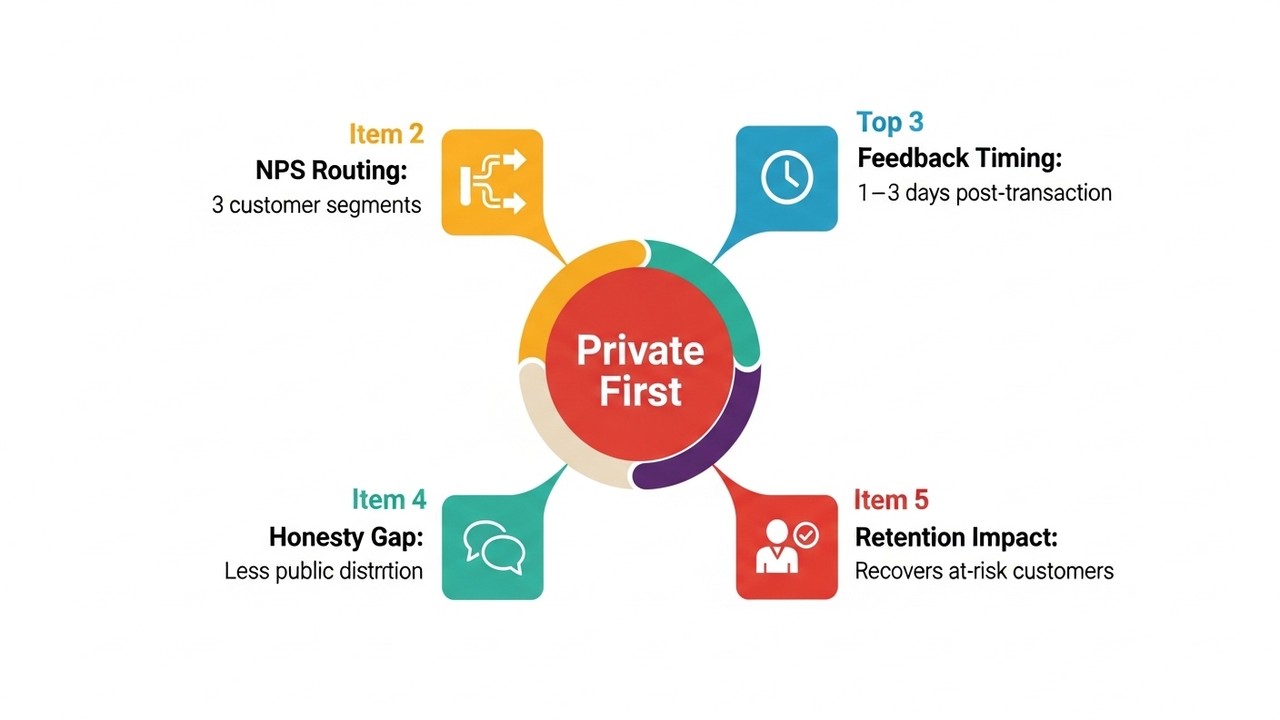
- NPS surveys help segment customers into promoters, passives, and detractors before any public review invitation is sent. Only promoters should be routed to public platforms while detractors enter a private resolution process.
- A consistent and automated internal feedback collection process, timed within one to three days of a completed transaction, ensures no customer interaction falls through the cracks and your data reflects real experience.
- Businesses that apply a private first feedback strategy consistently see higher review volume, improved average ratings, and stronger customer retention because dissatisfied customers receive resolution rather than a dead end.
Most businesses treat review collection as a single step: send a request, wait for a response, and hope for the best. But that approach skips a critical stage, one that determines whether the feedback you receive helps or hurts your reputation. The sequence in which you ask matters just as much as what you ask. When a customer has a poor experience and receives a public review request before anyone has privately checked in, that dissatisfaction has only one place to go. And it will go there publicly.
For businesses in Vancouver and across British Columbia managing their online presence, this sequencing issue is far from a minor operational detail. It is the difference between a reputation you build with intention and one shaped by circumstance. Upperly is built on the principle that honest, organic feedback collected in the right order produces results that are both more credible and more commercially useful.
What Happens When You Skip Private Feedback
Sending a public review request immediately after a transaction opens a direct line between a customer’s raw emotion and a visible platform. Customers who are unhappy and have no private outlet tend to escalate. Research consistently shows that public reviews on platforms like Google and Yelp are disproportionately driven by extreme emotional experiences, not representative sentiment. A business that skips internal feedback collection does not get an accurate picture of its customer base. It gets the edges.
The reputational cost compounds over time. A single negative public review, particularly one that could have been intercepted privately, can suppress conversions for months. In competitive local markets like Vancouver’s Lower Mainland, where customers routinely compare service providers before making a decision, that impact is especially significant. There is also a silent retention risk: dissatisfied customers who have no direct channel to raise concerns often simply leave, and the business never learns why. Fixing the sequencing problem means you stop losing customers quietly and start recovering them deliberately.
The Key Benefits of Private Customer Feedback Before a Public Ask
Private feedback creates a buffer between a negative experience and a public platform. Instead of a frustrated customer typing directly into a Google review box, they have a structured, personal space to share what went wrong. That moment of being heard is often enough to shift the emotional state from resentment to resolution. The customer feels acknowledged. The business gains information it can act on.
Academic research supports this. According to a study published by the University of Chicago on social desirability bias, public responses represent an upper bound of socially desirable answering, while private responses are meaningfully less distorted by image concerns. In plain terms: customers writing publicly tend to moderate their tone based on how they expect to appear to other readers. Private feedback captures what customers actually think. Collecting that honest signal first gives your business something far more valuable than a star rating. It gives you the truth.
This approach also supports retention directly. When a dissatisfied customer submits private feedback and receives a genuine response, the relationship is not just preserved. It is often strengthened. A customer who felt ignored becomes one who felt prioritised. That shift has a meaningful impact on whether they return, refer others, or eventually leave a positive review voluntarily.
| Factor | Private Feedback | Public Review |
|---|---|---|
| Audience | Business only | Visible to anyone |
| Honesty level | Higher, less distorted by image concerns | Lower, moderated by social desirability |
| Actionability | High, specific and targeted insights | Varies, often vague or emotional |
| Retention impact | Strong, gives dissatisfied customers a resolution channel | Low, no direct recovery opportunity |
| Reputational risk | Low, contained internally | High, permanent and publicly visible |

How Catching Unhappy Customers Early Changes the Outcome
There is a specific window between a completed transaction and the moment a customer decides to share their experience publicly. That window may be hours or a few days, depending on your industry. Businesses that send a private feedback request within that window can intercept dissatisfaction before it becomes a public problem. Those that wait too long, or skip private collection entirely, lose that window permanently.
When a dissatisfied customer receives a private outlet during this period, two things tend to happen. First, they feel less compelled to seek a public platform to vent, because they already have an audience. Second, the business has a real opportunity to respond, acknowledge the issue, and offer a resolution. The act of asking privately signals that the business cares about the individual experience, not just its aggregate rating.
How NPS Surveys Identify At-Risk Customers
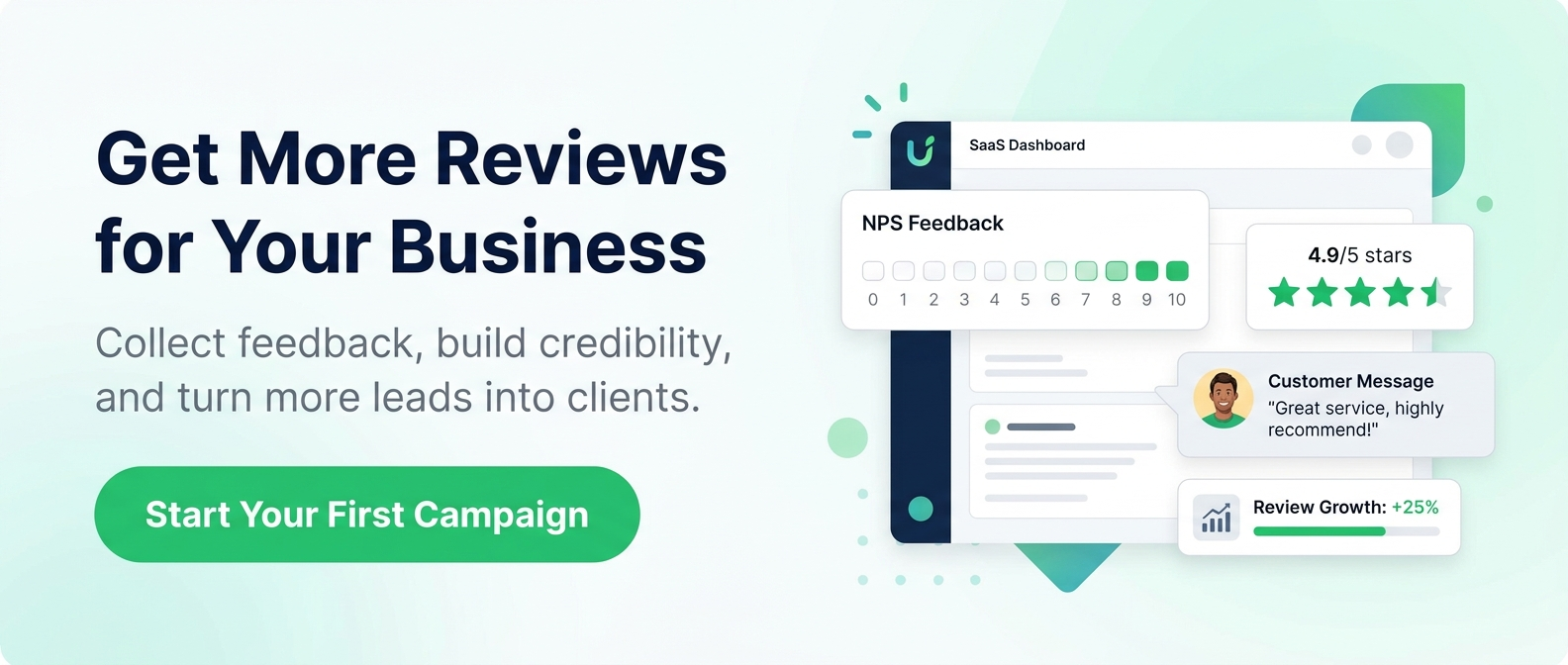
Net Promoter Score (NPS) surveys are one of the most reliable tools for spotting at-risk customers before any public review request is sent. Customers rate their experience on a scale of 0 to 10, segmenting them into three groups:
- Promoters (9 to 10): Invite them to leave a public review.
- Passives (7 to 8): Consider a follow-up check-in before any public ask.
- Detractors (0 to 6): Route them immediately into a private service recovery process.
This segmentation is operational, not just informational. It protects public platforms from becoming a destination for unresolved frustration while improving the overall quality of your review profile.
Building an Internal Feedback Collection Process That Works
A reliable internal feedback loop has three non-negotiable components:
- Timing: A well-calibrated automated sequence, typically sent one to three days after a completed service or purchase, hits the optimal window for honest, emotionally fresh responses.
- Simplicity: The survey should be concise, structured, and easy to complete on any device.
- Consistency: An automated process ensures no interaction falls through the cracks and that your data is representative enough to act on with confidence.
| Component | What It Means | Why It Matters |
|---|---|---|
| Timing | Send request one to three days after transaction | Captures honest responses while experience is fresh |
| Simplicity | Concise, structured, mobile-friendly survey | Increases completion rates and response quality |
| Consistency | Automated process for every customer interaction | Ensures representative data and no missed opportunities |
Why Linking Feedback to Individual Employees Matters
One of the most powerful and underused features of a structured feedback system is the ability to tie responses to specific employees rather than just the business as a whole. When a rating connects to a particular team member, managers gain precision on where service issues originate. Instead of retraining an entire team based on a vague pattern, a manager can address a specific interaction with a specific person. That makes coaching more effective and resolution more targeted.

Using Private Feedback as a Filter Before Requesting Public Reviews
The most effective reputation management systems use private feedback as a routing mechanism. The process works as follows:
- Send a private satisfaction survey after every relevant customer interaction.
- Use responses to route customers in one of two directions:
- Satisfied customers receive an invitation to share their experience on a public platform such as Google, Facebook, Yelp, or the BBB.
- Dissatisfied customers are routed into an internal resolution process, not toward a public platform.
This is how the broader question of customer feedback vs online reviews becomes a strategic framework rather than a binary choice. Research from the Indian Institute of Management published via SSRN found that private feedback consistently produced higher, more truthful, and more nuanced scores than public feedback in an experimental setting. Using that signal to decide who receives a public review invitation is responsible reputation management, not manipulation.
What to Confirm Before Automating Your Feedback Strategy
Automation makes internal feedback collection scalable and consistent, but it requires careful setup. Before deploying an automated review collection system, confirm the following:
- Email timing aligns with your specific transaction cycle.
- Message tone feels personal rather than template-generated.
- Your customer list is properly segmented so requests only go to people with a recent interaction.
Automation alone is not always sufficient. High-ticket services, complex client relationships, or businesses with a small and close-knit customer base, common across many professional and trades services in Metro Vancouver, may need a more hands-on approach alongside automated tools. Upperly’s done-for-you setup option exists for exactly this reason: some businesses need the system configured correctly from the start rather than learning through trial and error.

How a Private-First Strategy Supports Long-Term Reputation Growth
Treating private feedback collection as an ongoing filter, rather than a one-time campaign, changes what reputation management looks like over months and years. Businesses that consistently apply this approach tend to see improvements across three areas:
- Review volume increases because satisfied customers are reliably invited to share.
- Average ratings improve because detractors are intercepted before they post publicly.
- Customer retention strengthens because dissatisfied customers receive a resolution channel rather than a dead end.
Understanding how to turn customer feedback into better reviews begins with this internal discipline. A systematic review published in the Journal of Leadership and Organizational Studies via ScienceDirect found that feedback quality, not just its presence, is a key determinant of performance improvement, and that structured private feedback mechanisms tend to outperform unguided public channels in generating actionable insights. Businesses that build structured private feedback loops do not just protect their ratings. They build the kind of credible, organic review profile that earns genuine trust from prospective customers.
If you are ready to put a private-first feedback strategy to work, Upperly makes it straightforward to get started. Whether you are running a service-based business in Vancouver, managing multiple locations across the Lower Mainland, or prefer a fully configured setup, the platform is designed to help you collect honest feedback, protect your reputation, and grow your reviews with confidence. Reach out today to see how it fits your business.
Frequently Asked Questions
What is private feedback and how is it different from a public review?
Private feedback is collected through a direct, internal channel such as an email survey, and only the business sees it. A public review is posted on platforms like Google or Yelp and is visible to anyone. Because customers are not writing for an audience, private feedback tends to be more honest and more actionable than most public reviews.
Is routing unhappy customers away from public platforms allowed by Google?
Google’s review policies prohibit selectively soliciting only positive reviews or discouraging negative ones through deceptive means. A private-first strategy that gives all customers a feedback channel, and then invites satisfied customers to post publicly, is a legitimate approach. The key is that every customer has an equal opportunity to be heard privately before any public invitation is sent.
How soon after a transaction should a private feedback request be sent?
The optimal window is typically one to three days after a completed service or purchase. Sending too soon can feel intrusive; waiting too long means customers may have already shared their opinion elsewhere. The right timing varies by industry, but staying within this range captures responses while the experience is still fresh and relevant.
Can private feedback help improve staff performance?
Yes. When feedback is tied to specific employees rather than the business overall, managers can identify exactly where service issues occur. This makes coaching conversations more precise and more fair. Instead of responding to vague trends, a manager can address a specific interaction with a specific team member, which supports faster and more effective improvement.
Does this approach work for small businesses with few customers?
Yes, and it may matter even more for smaller businesses. With fewer customers, each public review carries more weight. A private-first process helps protect every relationship and ensures a single unhappy customer does not define your public reputation. For small or relationship-based businesses in Vancouver, combining a hands-on feedback approach with automated tools is often the most effective option.
Social Share


How Review Request Campaigns Work and Drive Real Results
Key Takeaways A structured review request campaign automates the process of collecting customer reviews, driving measurable gains in volume, local search visibility, and brand…


How NPS Fits Into Your Customer Workflows
Key Takeaways NPS data delivers real business value only when it flows automatically into your CRM, helpdesk, and customer workflows so your team can act…

How to Turn Customer Feedback into Better Reviews
Key Takeaways Turning customer feedback into better reviews requires a connected system that segments sentiment, times requests strategically, and closes the loop between private…

Smart Questions to Ask Before Buying Review Software
Key Takeaways Ask the right questions about data ownership, pricing, automation, and integrations before committing to any review software platform. Every question you bring into…