

 Home
HomePrivate Feedback vs Public Reviews: What Each Does for Your Business

 Category:Articles
 June 4, 2026 / AT: 10:08 AM
 264 View
 No Comment
Key Takeaways
Private feedback improves your operations internally, while public reviews build credibility with strangers — and small businesses need both working together to grow.
- Private feedback and public reviews serve distinct purposes: internal feedback reveals honest operational gaps, while public reviews shape how potential customers perceive your business before any interaction.
- NPS scores tracked at the employee level offer granular service intelligence that star ratings simply cannot — helping you coach the right people and retain more customers.
- Automated feedback collection creates an intervention window: satisfied customers are guided to leave public reviews, while dissatisfied ones are routed to private resolution before frustration goes public.
- Businesses that consistently act on private feedback — refining training, fixing processes, following up on concerns — tend to see their public review scores rise organically over time.
- Before choosing a reputation tool, evaluate ease of use, cost structure, platform compatibility (Google, Facebook, Yelp), employee-level tracking, and whether a done-for-you setup option is available.
Most small business owners know they need more reviews and better customer feedback — but far fewer realise these are two different tools serving two very different purposes. When it comes to customer feedback vs online reviews, mixing them up is one of the most common and costly mistakes in reputation management. One works behind the scenes to sharpen how you operate; the other lives in public and shapes how strangers perceive you before they ever walk through your door.
For businesses in Vancouver and across the Lower Mainland, where competition for local customers is visible and searchable, both tools matter — but only when you understand what each one is actually for. Whether you operate in Kitsilano, Burnaby, North Vancouver, or the Fraser Valley, this article breaks down the distinction, explains the strategic role each plays, and shows how connecting the two creates a reputation system that works without constant manual effort.
What Is the Difference Between Customer Feedback and Online Reviews?
Customer feedback is private input collected directly from customers after an interaction. It is meant for your eyes — a candid, honest signal about what is working and what is not. An online review is a public opinion posted on platforms like Google, Facebook, or Yelp, written for strangers who are deciding whether to trust your business.
Both involve customers sharing opinions, which is why they are so often confused. But treating them interchangeably means you are likely underusing one and mismanaging the other.
Private feedback tells you what is happening inside your business — problems, patterns, and opportunities your team can act on. Public reviews tell potential customers what other people think of your business — and directly influence whether those customers choose you.
Businesses that focus only on collecting reviews miss the internal intelligence that private feedback provides, often discovering problems only after they have already damaged customer relationships. Businesses that focus only on internal feedback end up with great service but no visible proof of it — which is just as damaging in a market where how online reviews influence customer trust has become a baseline expectation, not a bonus.
| Dimension | Customer Feedback | Online Reviews |
|---|---|---|
| Visibility | Private — seen only by the business | Public — visible to anyone searching your business |
| Primary audience | Business owner and team | Prospective customers |
| Main purpose | Improve internal operations and service | Build public credibility and trust |
| Typical format | Email surveys, NPS, employee-specific ratings | Star ratings and written comments on Google, Yelp, Facebook |
| Customer candour | Higher — lower-stakes environment | Lower — publicly visible, often softened |
| Strategic role | Input — feeds operational improvements | Output — reflects the quality of your service publicly |
What Customer Feedback Is Really For

Customer feedback, in its truest sense, is structured input collected privately after an interaction with your business. Because it is private, customers tend to be more direct. They will flag a rude employee, mention a billing confusion, or describe exactly what fell short — in ways they might soften or avoid entirely in a public forum.
Formats matter here. Email surveys, satisfaction questions, and employee-specific feedback all serve different diagnostic purposes. A business owner using these tools is not just collecting opinions — they are tracking patterns across customers, staff, and service moments. That intelligence feeds directly into retention decisions, training priorities, and operational improvements that no star rating can surface on its own.
What NPS Scores Reveal That Star Ratings Don’t
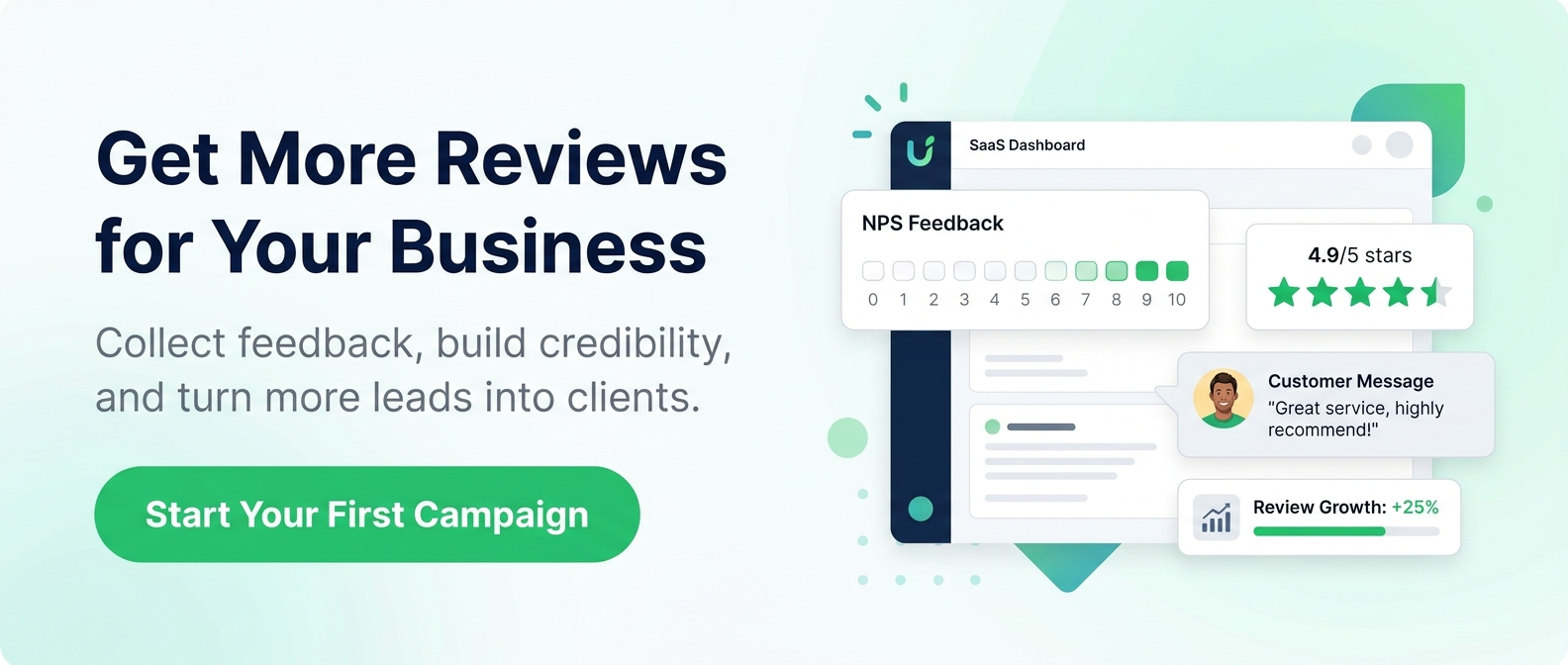
The Net Promoter Score (NPS) asks one simple question: on a scale of 0 to 10, how likely are you to recommend this business to someone you know? The simplicity is deliberate. It produces a consistent, comparable signal over time — something a star rating cannot replicate, since ratings vary by platform, context, and reviewer mood.
NPS lets you track whether customer sentiment is improving or declining across weeks, seasons, or team changes — and it is sensitive enough to catch warning signs early.
One particularly useful application is tracking NPS at the employee level. When feedback is tied to a specific staff member, you can identify who is consistently delighting customers and who may need coaching. This kind of detail rarely surfaces in a public review, where customers typically describe their visit without naming a specific person. For service businesses across Vancouver — from trades and wellness studios to cafés and retail shops — where individual interactions drive retention, employee-level feedback tracking offers a real operational advantage.
How Online Reviews Build Public Perception
An online review is a customer’s written opinion posted publicly on a third-party platform, visible to anyone who searches for your business. Unlike private feedback, it is not addressed to you — it is addressed to strangers who are deciding whether to trust you.
That distinction changes how reviews should be managed. According to research published in the International Journal for Research in Applied Science and Engineering Technology, detailed qualitative reviews tend to have a stronger influence on purchasing decisions than star ratings alone.
The credibility of a public review profile generally depends on three factors: volume, which signals stability and reliability; recency, which shows that your quality is consistent now and not just historically; and consistency, which builds trust across platforms in a way that a few outlier reviews cannot.
According to SocialPilot, 73% of consumers read online reviews always or regularly when researching businesses. That means your public review profile is very likely where a potential customer forms their first impression of you — often before they visit your website.
How Private Feedback and Public Reviews Work Together as a Strategy
Once you understand what each tool is for, the strategic picture becomes clear. Private feedback improves what happens inside your business. Public reviews communicate that quality to the outside world. These are not competing priorities — they are sequential ones.
You cannot consistently generate strong public reviews without first running a business that earns them. And you cannot know whether you are earning them without structured feedback that captures honest customer experience.
The businesses that grow their reputation most effectively treat feedback as an input and reviews as an output. They use private signals to fix problems, train staff, and strengthen service — then they systematically invite satisfied customers to share their experience publicly. Research from BrightLocal’s Local Consumer Review Survey suggests that consumers often treat online reviews with a level of trust similar to personal recommendations. For Vancouver businesses competing in densely populated neighbourhoods where word of mouth has always mattered, every genuine public review carries meaningful weight.
How Private Feedback Prevents Public Problems for Vancouver Businesses
One of the most practical reasons why private feedback matters before public reviews is the intervention window it creates. When a customer has a poor experience and you reach them privately first, you can acknowledge the issue, make it right, and preserve the relationship — before frustration turns into a one-star review on Google.
That window is narrow and rarely happens by accident. It requires a deliberate process of collecting feedback promptly after every customer interaction. This is where automated email tools become genuinely useful. Rather than relying on staff to remember every follow-up, an automated system sends feedback requests consistently and routes responses based on sentiment: customers who report a positive experience are guided toward leaving a public review, while customers who flag a concern are directed to a private resolution channel instead.
This approach is not about gaming the system. It is about ensuring that satisfied customers — who would never think to leave a review unprompted — are given an easy, frictionless way to do so, while dissatisfied customers receive attention before a public complaint becomes the only option left.
The Feedback-to-Reputation Connection Most Businesses Overlook
There is a direct but often invisible connection between what businesses learn privately and what eventually appears publicly. Businesses that act consistently on customer feedback — adjusting training, refining processes, following up on concerns — tend to see their public review scores improve gradually over time. This is not coincidence. It is the natural outcome of a business that listens and improves before asking for public validation.
Understanding how to turn customer feedback into better reviews is not about shortcuts — it is about building the operational foundation that makes positive reviews the honest result.
The practical obstacle for most small businesses is not understanding this connection — it is finding the time and structure to act on it. Manually sending follow-up emails, sorting through responses, and remembering to invite happy customers to leave reviews breaks down quickly without automation. Industry sources suggest that unaddressed customer feedback can contribute to higher churn rates, reflecting both the retention cost of silence and the compounding damage of unresolved dissatisfaction.
A done-for-you setup combined with automated email campaigns removes the manual burden that stops most small business owners from running this process at all — making it sustainable rather than aspirational.
What to Look for Before Choosing a Feedback or Review Tool

Not all reputation tools are built with small business realities in mind. Before committing to any platform, ask these practical questions:
- Is it easy to use? Can you set it up and run it without technical support? A tool that requires ongoing configuration defeats the purpose of automation.
- How is it priced? Does it charge a flat monthly fee regardless of usage, or can you pay based on actual activity? Flexible pricing lets you start small without financial risk.
- Does it connect to the right platforms? Look for compatibility with Google, Facebook, Yelp, and the BBB — the platforms your customers actually use.
- Can it track feedback by employee? If service quality depends on individual staff members, you need reporting at that level.
- Is there a full-service option? Some business owners want the system running without handling the setup themselves — look for a provider that offers that.
| Evaluation Factor | What to Look For | Why It Matters |
|---|---|---|
| Ease of use | No technical setup required; runs independently | Saves time and avoids reliance on ongoing support |
| Pricing model | Flat fee or usage-based; no lock-in | Lets you start small without financial risk |
| Platform compatibility | Google, Facebook, Yelp, BBB | Reaches the platforms your customers actually use |
| Employee-level tracking | Feedback tied to individual staff members | Identifies coaching needs and top performers |
| Full-service option | Provider handles setup and management | Keeps the system running without owner involvement |
The direction of travel in reputation management is clear: authentic, verified reviews from real customers are becoming more valuable over time. Businesses that collect genuine customer feedback consistently are better positioned than those relying on volume alone — and that is the standard worth building toward.
At Upperly, we built our platform specifically for small business owners in Vancouver and across the Lower Mainland who want a straightforward, effective way to collect real feedback and earn more genuine reviews — without the complexity or subscription lock-in that makes most tools impractical. If you are ready to start building a reputation that reflects the quality of your service, we would be glad to show you how simple that process can be.

Frequently Asked Questions About Customer Feedback vs Online Reviews
What is the main difference between customer feedback and online reviews?
Customer feedback is private input shared directly with your business, used to improve operations and service. Online reviews are public opinions posted on platforms like Google or Yelp, visible to anyone researching your business. Feedback informs how you operate internally; reviews shape how strangers perceive you before they become customers.
Can private customer feedback improve my Google review score?
Yes, indirectly. When you act on private feedback to fix service issues, satisfied customers are more likely to leave positive public reviews. Businesses that consistently collect and respond to private feedback tend to see their public scores improve over time as a natural result of better service.
Why do some customers leave honest feedback privately but not publicly?
Private channels feel lower stakes. Customers are more willing to flag a specific problem — a billing issue, a staff interaction — when they are not publishing it publicly. That candour is exactly what makes private feedback so valuable for identifying real issues before they escalate into public complaints.
What is NPS and why does it matter for small businesses?
NPS, or Net Promoter Score, measures how likely customers are to recommend your business on a scale of 0 to 10. Unlike star ratings, it produces a consistent signal you can track over time across seasons, staff changes, and service adjustments. For small businesses, it is a useful early-warning system for declining customer sentiment.
Is it acceptable to route positive feedback toward public review platforms?
Yes, provided the process is transparent and reviews reflect genuine experiences. Prompting satisfied customers who might never think to leave a review unprompted is a widely accepted practice. The key is that no fabrication or incentivisation is involved — only a frictionless invitation to customers who already had a good experience.
How often should a small business collect customer feedback?
Ideally after every customer interaction, typically through an automated follow-up email sent within 24 to 48 hours. Consistency matters more than volume — regular collection lets you track sentiment over time and catch problems early, rather than relying on occasional surveys that only capture a partial picture.
Social Share


How Online Reviews Shape Customer Trust and Buying Decisions
Online reviews are now the primary trust signal for small businesses, directly shaping whether potential customers contact you or choose a competitor. 93% of…

How NPS Fits Into Your Customer Workflows
Key Takeaways NPS data delivers real business value only when it flows automatically into your CRM, helpdesk, and customer workflows so your team can act…

How to Choose Review Management Tools That Drive Results
Key Takeaways Upperly outlines a practical, goal-first framework to help Vancouver marketing teams choose review management tools that deliver measurable results. Start by auditing your…

Online review management
One of the best services provided by Google is Google review. This service will enable people to express their opinions on almost anything. If you…