

 Home
HomeWhen Is the Best Time to Ask Customers for a Review?

 Category:Articles
 June 13, 2026 / AT: 10:14 AM
 130 View
 No Comment
Key Takeaways
Asking customers for a review at the right moment after their purchase dramatically increases response rates and the quality of feedback your business receives.
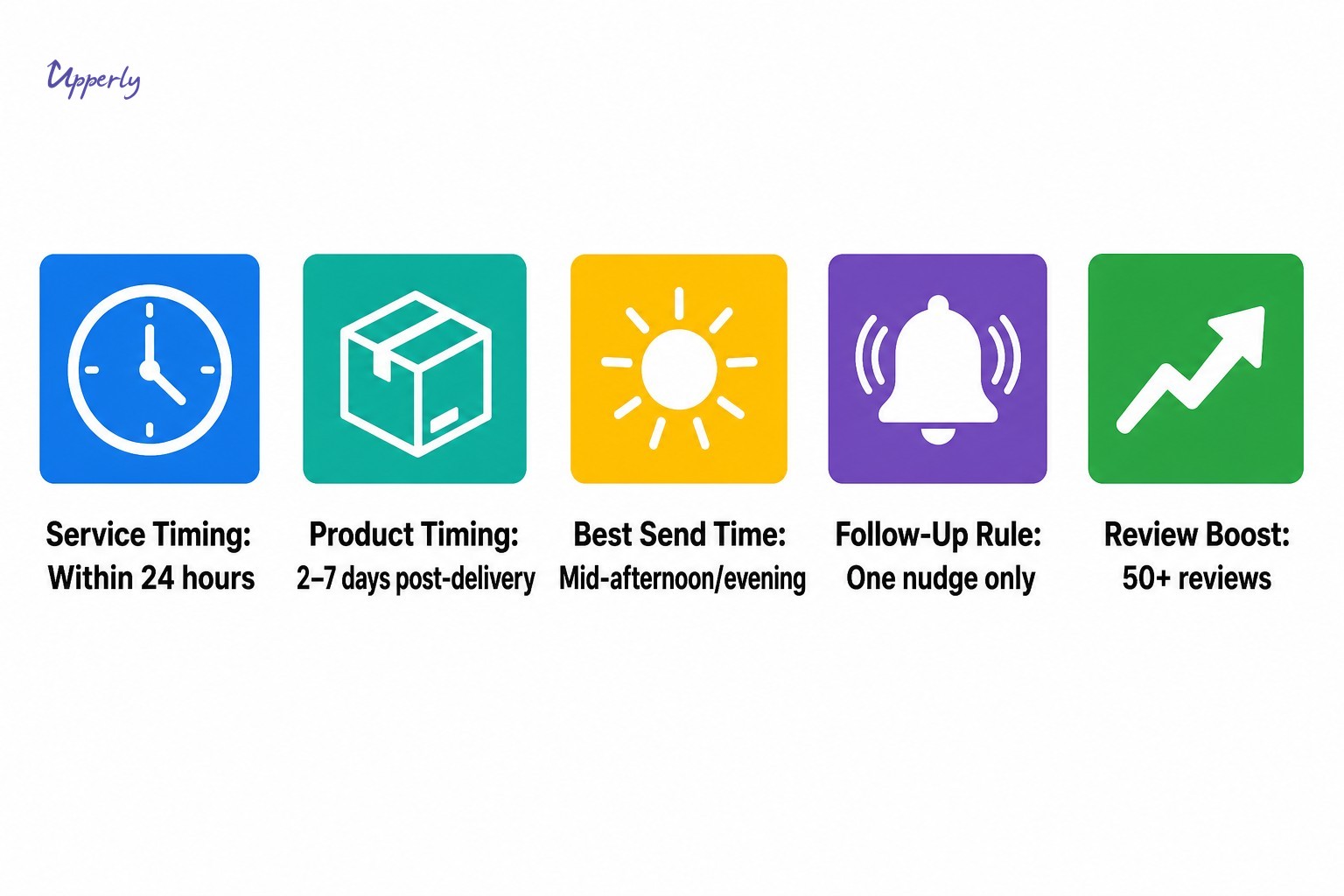
- For product based businesses, send your review request two to seven days after delivery so customers have had enough time to genuinely evaluate what they received.
- For service and appointment based businesses, a follow up within 24 hours works best because the memory and emotion from the experience are still fresh and vivid.
- A two touch outreach approach, where a second message goes out a few days after the first, can improve overall response rates by as much as 60 percent.
- Sending an NPS survey before the review request helps you identify satisfied customers first, making your review invitation timing more effective and less intrusive.
- Automating your review request sequence removes the reliance on manual effort, ensuring every customer is contacted at the right interval without daily management.
For small business owners in Vancouver and across British Columbia, online reviews are one of the most powerful tools for building credibility and attracting new customers. Whether you run a café in Gastown, a trades business serving the North Shore, or a wellness studio in Kitsilano, knowing when to ask can mean the difference between a steady stream of positive feedback and a near-empty profile that does little to inspire confidence. Timing is not a minor detail. It is a strategic decision that shapes how many customers respond, how they feel about being asked, and ultimately what they write.
Most business owners either ask too soon, before the customer has formed a real opinion, or too late, after the enthusiasm has faded. Both approaches leave results on the table. Understanding the right moment to ask, and doing it consistently, turns an occasional ask into a repeatable system that brings in honest, high-quality feedback.
Why Review Timing After Purchase Changes Everything
When you ask at the right moment, customers are emotionally engaged, their experience is vivid, and their motivation to share is high. Ask too early and they may not have fully evaluated what they received. Ask too late and the moment has passed.
Research published by Harvard Business Review explains it well: customers who are asked too early can feel pressured and rushed, before they have had time to properly evaluate what they received. Patience is part of the strategy. Poor timing can make an otherwise happy customer feel uncomfortable rather than appreciated.
There is also a strong business case for getting this right. According to ReviewTrackers, having 50 or more reviews can meaningfully boost search rankings and click-through rates compared to businesses with no reviews at all. In a competitive local market like Metro Vancouver, where customers routinely compare Google Business profiles before choosing a service, that kind of visibility comes from building a consistent, well-timed outreach habit.

Ideal Review Request Timing by Business Type
There is no single universal answer, because the right window depends on what kind of business you run. The common thread is finding the moment when a customer has had enough time to form a clear impression but has not yet moved on mentally. That is when satisfaction tends to peak and the motivation to share is highest.
Product-Based Businesses
For businesses that sell physical products, send your review request two to seven days after delivery. This gives the customer time to unbox, use, and genuinely evaluate what they received. Asking on the same day the package arrives assumes they have already formed a complete opinion, which is rarely the case.
A follow-up reminder a few days after the first ask is also worth building into your process. PowerReviews found that a large share of customers respond after the first request, while a meaningful portion only respond after a second nudge.
Service-Based and Appointment Businesses in Vancouver
For service businesses, the experience is complete the moment the appointment ends, so the best time to ask is the same day or within 24 hours. Whether you run a hair salon in Mount Pleasant, a home renovation company serving Burnaby and Coquitlam, a physiotherapy clinic in South Granville, or a fitness studio in the West End, the principle is the same: the memory is fresh, the emotion is intact, and the customer can describe exactly what happened.
Waiting several days risks losing that specificity. The client moves on, the details blur, and the motivation to write something meaningful drops. A prompt, polite follow-up within 24 hours is typically the sweet spot.
| Business Type | Ideal Timing | Reason | Follow-Up Recommended |
|---|---|---|---|
| Product-based (e-commerce, retail) | 2 to 7 days after delivery | Gives customer time to unbox, use, and evaluate the product | Yes, a few days after first request |
| Service-based (salon, trades, clinic, fitness) | Same day or within 24 hours | Experience is complete; memory and emotion are at their peak | Yes, if no response within a few days |
Review Request Timing by Channel
The channel you use affects not just delivery but also the timing that works best.
- Email: The most reliable channel for post-purchase review requests. It gives customers space to read at their own pace and is well-suited for slightly delayed sends.
- SMS: Gets faster attention, making it ideal for service businesses that want a same-day follow-up without feeling intrusive.
- In-person: Works well at checkout or at the close of an appointment, especially when the interaction has been warm and the customer is visibly pleased.
| Channel | Best For | Ideal Send Timing | Key Advantage |
|---|---|---|---|
| Product businesses, delayed follow-ups | Mid-afternoon or early evening | Gives customers space to respond at their own pace | |
| SMS | Service businesses, same-day follow-ups | Shortly after appointment | Fast attention, feels timely and personal |
| In-person | Any business with face-to-face interaction | At checkout or end of appointment | Capitalizes on warm, immediate experience |
Regardless of channel, timing within the day also matters. Sending requests mid-afternoon or early evening tends to generate stronger engagement. One of the most practical advantages of understanding how review request campaigns work is that automated sequences remove the guesswork entirely. The request goes out at the right interval every time, without manual follow-up.
Common Timing Mistakes Small Business Owners Make
Avoiding a few key errors can significantly improve your response rates. The most common mistakes are sending a generic blast to your entire list at once (where customers who purchased three weeks ago receive the same message as someone who bought yesterday), waiting too long after the transaction, and never following up after the initial request.
Research from the Universities of Nevada and Arizona State found that without a follow-up, the number of reviews can drop sharply after nine or more days. A second message sent a few days after the first may improve overall response rates considerably, according to data from Reputation.
How to Refine Your Timing Over Time
No timing strategy should be set and forgotten. Track open rates and response rates on your review request emails to learn what works for your specific customers. If emails are being opened but not acted on, the timing or message may need adjustment. If open rates are low, the send time or subject line could be the issue.
NPS surveys are a valuable complement to direct review requests. By sending a short Net Promoter Score survey before the review ask, you can identify which customers are genuinely satisfied and then direct them toward a public platform. This creates a natural two-step experience that feels less transactional. For businesses figuring out how to ask for reviews without annoying customers, this segmented approach is one of the most effective options available.
What to Check Before Sending Review Requests
Before launching any automated review collection campaign, confirm two things. First, review the platform guidelines: Google, Yelp, and other major platforms prohibit incentivized reviews, and violations can result in reviews being removed or penalties applied to your listing. Second, verify your contact list and only send requests to genuine customers who completed a real transaction. Sending to anyone else undermines the credibility of your reviews and puts your reputation at risk.
Collecting only authentic feedback is not just a platform requirement. It is the foundation of the trust your business is trying to build. When customers are asked appropriately, research suggests a large proportion are willing to leave a review, which means your outreach can deliver real results when the approach is right.
A Simple Setup for Busy Vancouver Business Owners
If you do not have time to manage send schedules, follow-up sequences, and platform-specific formatting manually, automated review collection tools are the practical solution. A well-configured system handles the entire timing process, from the initial post-purchase request to the follow-up nudge, without requiring daily input.
Upperly is built with exactly this kind of simplicity in mind. The platform handles automated email outreach, NPS-based satisfaction screening, and multi-platform review direction, all without a subscription commitment. For business owners in Vancouver who prefer not to configure tools themselves, the done-for-you setup option means you can have a complete review collection system in place without spending hours learning new software. If you are ready to start collecting more reviews with better timing and less effort, Upperly is set up to make that happen for you.
Frequently Asked Questions
What is the single best time to send a review request?
The best time is shortly after the customer has had enough experience to form a clear opinion. For service businesses, that means the same day or within 24 hours of the appointment. For product businesses, two to seven days after delivery is the ideal window. Mid-afternoon or early evening tends to produce the strongest open and response rates.
Should I ask for a review in person or send a message afterward?
Both approaches work, and the right choice depends on your business. In-person requests are effective when the interaction has been warm and the customer is visibly satisfied. A follow-up by email or SMS is useful because it gives customers a direct link to your review platform and lets them respond at their own pace.
How many times should I follow up if a customer does not respond?
One follow-up is generally enough. Sending a second message a few days after the first can recover customers who missed the initial request. Sending more than two messages risks feeling pushy, which can damage the customer relationship you are working to build.
Does timing affect the quality of reviews, not just the quantity?
Yes. When you ask at the right moment, customers can recall specific details about their experience, which leads to more descriptive and credible reviews. Vague or generic reviews are often the result of asking too late, when the memory has faded and the customer feels less connected to what happened.
Are there rules I need to follow when asking for reviews in Canada?
Canada’s Anti-Spam Legislation (CASL) requires express or implied consent before sending commercial electronic messages, including review requests. You must identify your business clearly and include a way to unsubscribe. Beyond that, major platforms like Google and Yelp prohibit offering incentives in exchange for reviews. If you are unsure whether your process is compliant, consult a legal professional familiar with Canadian digital marketing law.
Social Share



How to Choose Review Management Tools That Drive Results
Key Takeaways Upperly outlines a practical, goal-first framework to help Vancouver marketing teams choose review management tools that deliver measurable results. Start by auditing your…


Review Management Software Features That Drive Real Results
Key Takeaways Upperly breaks down the review management software features that actually drive measurable results for Canadian marketing and growth teams. Focus on outcome-relevant features…

What is SEO and how can it be improved by getting reviews?
The SEO is derived from the expression "Search Engine Optimization" which has equivalent words such as SEO or search engine optimization, all of which are…

How To Calculate Customer Retention Rate?
The key to business and revenue growth in your company is not just to attract new customers; the key is customer retention. Whether you have…