

 Home
HomeHow Star Ratings Shape First Impressions With Buyers
 Category:Articles
 June 15, 2026 / AT: 1:20 PM
 8 View
 No Comment
Key Takeaways
Star ratings shape buyer decisions instantly, and small businesses in Vancouver can build credible, lasting ratings by collecting consistent, timely, and authentic customer feedback.
- Star ratings create a first impression before any business copy is read; buyers use them as a primary trust signal within a fraction of a second of seeing a listing.
- Businesses with ratings below 4.0 are algorithmically excluded from high intent searches containing terms like ‘best’ or ‘top’ on Google, making rating improvement a discoverability issue, not just a perception issue.
- A rating of 4.5 to 4.7 often outperforms a perfect 5.0 because buyers find realistic scores more authentic and credible than flawless ones.
- Review recency and volume matter as much as the score itself; a steady stream of recent reviews signals that a business is active and consistently delivering quality today.
- The most effective way to improve your rating is to build a simple, automated follow up process that asks satisfied customers for reviews at the right moment without requiring heavy manual effort.
Before a potential customer reads your business description, checks your hours, or clicks through to your website, they have already formed an opinion. That opinion is built on a small cluster of yellow stars and a number sitting next to your business name. For small business owners in Vancouver competing in crowded local markets, from Kitsilano cafés to Commercial Drive boutiques to Gastown service providers, this silent signal carries enormous weight. Understanding it is not a minor marketing detail. It is the foundation on which every first-contact effort either succeeds or falls apart.
A strong rating is not reserved for large brands with big marketing budgets. Any business can build one with the right approach to collecting consistent, honest feedback from real customers. This article explains why the star rating matters so much, what it communicates to buyers, and what you can do to improve it in a way that holds up over time.
Why Your Star Rating Speaks Before You Do
When a buyer scans a search results page or a Google Maps listing, their eyes move fast. Consumers treat star ratings as a primary trust signal, comparable in influence to price, brand reputation, and even personal recommendations. That initial glance takes a fraction of a second, yet it determines whether your business earns a click or gets scrolled past.
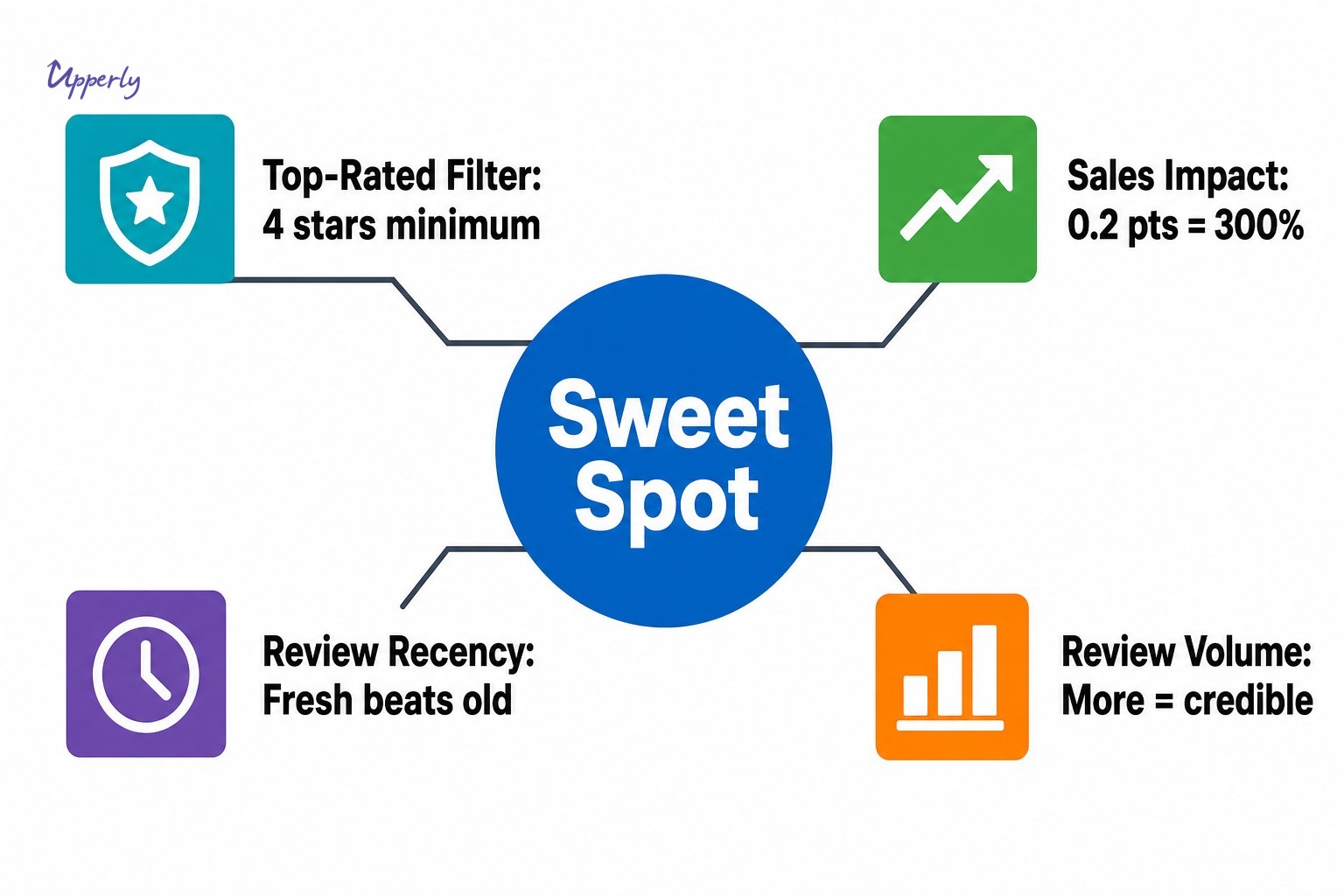
Platform context also matters. According to research documented by Luau Group, when searches include terms like “best” or “top,” Google automatically triggers the “Top-rated” filter, showing only businesses with a 4-star rating or higher. Businesses below that threshold are algorithmically excluded from the searches most likely to convert. Your rating is not just a perception issue. It is a discoverability issue that directly affects who can find you in the first place.

The Psychology Behind Star Ratings and Buyer Trust
Star rating psychology is rooted in how the brain processes social proof. When a buyer sees a rating, they are not doing a careful analysis. They are running a fast, automatic pattern-recognition check. A high score triggers reassurance. A low or middling score triggers caution. This cognitive shortcut happens before conscious reasoning even kicks in.
How the rating is displayed also changes how buyers perceive it. A study published in the Journal of Marketing Research found that consumers view a 3.5-rated product as higher and better when displayed as visual stars compared to plain numerals. As co-author Carter Morgan noted: “Small changes in the presentation of product ratings can have significant effects on consumer behavior in the online marketplace.” How your rating appears visually shapes buyer perception as much as the score itself.
Why a 4.7 Often Outperforms a Perfect 5.0
A perfect five-star score sounds ideal, but buyers are increasingly sceptical of flawless ratings. When every review is glowing with no variation, it can feel curated rather than authentic. A realistic high rating, such as 4.6 or 4.7, reads as genuinely earned because it reflects natural human experience. The slight imperfection signals credibility.
A score of 4.5 frequently outperforms a perfect 5.0 in conversion precisely because it feels more authentic. For business owners who feel discouraged by the occasional critical review, this is worth remembering: honest variation is not damaging your reputation. In many cases, it is strengthening it.
The Drop-Off Zone: Where Buyer Interest Fades
There is a clear threshold below which buyer interest drops sharply. Businesses in the 3.0 to 3.9 range tend to experience significantly weaker conversion rates, not just because the score looks lower, but because buyers interpret it as a pattern of inconsistency or unresolved problems.
Research from Cornell SC Johnson College of Business found that a rating jump of just 0.2 points can increase sales by up to 300%. That figure underscores how commercially significant even a modest improvement can be, particularly for businesses stuck in that vulnerable middle range.
| Rating Range | Buyer Perception | Conversion Impact |
|---|---|---|
| 5.0 | May appear curated or inauthentic | Can underperform due to scepticism |
| 4.5 to 4.9 | Trusted as genuinely earned; feels authentic | Highest conversion; strong credibility signal |
| 4.0 to 4.4 | Generally positive; meets Google “Top-rated” threshold | Good conversion; eligible for filtered searches |
| 3.0 to 3.9 | Signals inconsistency or unresolved issues | Significantly weaker conversion; excluded from top filters |
| Below 3.0 | Raises serious trust concerns | Very low conversion; major discoverability impact |
How Your Average Rating Affects More Than Perception
A high average rating is a strong start, but it does not tell the whole story buyers are piecing together. The impact on buyer decisions is shaped by three factors working together: the score itself, the volume of reviews, and how recent those reviews are.
A business with a 4.8 rating built on 12 reviews from three years ago will be viewed very differently from a business with a 4.6 built on 200 reviews from the past six months. Buyers instinctively question whether an older rating still reflects the current team, service quality, or ownership. Keeping a fresh stream of incoming reviews signals that the business is active and still earning positive feedback right now.
This is where review recency and customer decision making become directly relevant, and why review volume affects business credibility so significantly. A larger pool of reviews makes any single outlier less impactful and lends statistical weight to the overall score. Response patterns matter too. Buyers notice when a business engages with feedback, both positive and critical, because it shows the business is paying attention and genuinely cares.
| Factor | What Buyers Look For | Why It Matters |
|---|---|---|
| Star score | 4.0 or higher; ideally 4.5 to 4.9 | Primary trust signal; determines eligibility for top-rated filters |
| Review volume | Larger pool of reviews | Reduces impact of outliers; adds statistical credibility to the score |
| Review recency | Steady flow of recent reviews | Signals the business is currently active and maintaining quality |

What Rating Signals Tell Buyers About Your Business
A consistently strong review score communicates more than quality. It signals reliability, giving buyers confidence that their experience will match what they expect. It signals responsiveness, especially when paired with owner replies to reviews. And it signals consistency, suggesting that good service is the norm rather than the exception. These are exactly the qualities buyers are trying to assess before committing to a purchase or an appointment.
The same score also reads differently depending on context. A 4.2 in the restaurant industry carries different weight than a 4.2 in a professional services category like legal or financial advice, where buyer stakes are higher and trust requirements are stricter. Visual format plays a role here too. Research from the Cornell SC Johnson College of Business found that participants rounded up 79% of half-star ratings displayed as stars, but rounded down 71% of the same ratings shown as numerals. How the score is presented shapes how it is perceived.
What a Star Rating Cannot Do on Its Own
A strong score will attract attention and earn initial trust, but it cannot compensate for a poor service experience once a buyer arrives. If the delivery does not match the promise the rating implied, the result is a disappointed customer who is likely to leave a negative review, working against the very score you built.
Business owners should also be cautious about patterns that look engineered. A sudden spike in reviews over a short period, or reviews that read as unusually uniform in tone, can raise red flags with both platforms and buyers. Authentic feedback collected consistently over time is what creates a credible rating profile. Honest variation in scores and review content is not a weakness. It is the texture of a genuine reputation.

How Vancouver Business Owners Can Improve Their Star Rating
The most effective way to improve your rating is to make asking for reviews a consistent, frictionless part of your customer follow-up process. Most businesses do not have a review problem. They have an asking problem. Customers who had positive experiences rarely leave reviews unprompted, not because they are unwilling, but because they forget or find the process inconvenient. Removing that friction changes the outcome.
Automated review collection tools solve this by sending a follow-up message to customers at the right moment, without requiring manual effort every time. Upperly’s automated email system handles this for businesses, sending review requests after customer interactions and directing satisfied customers to platforms like Google, Facebook, Yelp, and the BBB. The NPS survey tool adds another layer by identifying which customers are genuinely happy before the review request is sent, creating a targeted pipeline of people most likely to leave positive, authentic feedback.
What Drives Review Volume: Timing and Simplicity
Two variables determine whether a customer follows through on leaving a review. First, when they are asked: a request sent within 24 to 48 hours of the experience is far more likely to get a response than one sent a week later. Second, how easy the process is. The more clicks, logins, or navigation required, the more people drop off before finishing. Upperly’s platform is built around this principle, keeping the process simple enough that businesses can collect feedback at scale without heavy manual effort or a technical learning curve.
Building a Credible Rating That Holds Over Time
A single burst of review collection will improve your score temporarily, but it will not build the kind of rating profile that holds up over months and years. The businesses with the most credible reputations collect reviews consistently, respond to feedback actively, and use the data they gather to improve service delivery over time.
Upperly’s employee-specific feedback feature supports this by allowing businesses to track which team members are generating the strongest customer responses, connecting performance insights directly to the review strategy.
For small business owners in Vancouver who want real results without heavy ongoing effort, the path forward is straightforward: build a system that asks regularly, asks at the right time, and makes it easy for satisfied customers to share their experience. Whether you run a neighbourhood restaurant in Mount Pleasant, a trades business serving the North Shore, or a professional practice in downtown Vancouver, a rating built this way does not just look good today. It becomes a long-term credibility asset that compounds as review volume grows. If you are ready to start collecting more honest, organic reviews that move your score in the right direction, Upperly is built to make that process simple from day one.
Frequently Asked Questions About Star Ratings and Buyer First Impressions
How many stars does a Vancouver business need to appear in Google’s “Top-rated” filter?
Google requires a minimum of 4 stars for a business to appear when users search with terms like “best” or “top.” Businesses below this threshold are excluded from those filtered results, which tend to attract highly motivated buyers. Reaching and maintaining a 4-star rating is important for local discoverability in Vancouver.
Is a perfect 5-star rating better than a 4.7?
Not always. Buyers often trust a 4.6 or 4.7 more than a perfect 5.0 because a flawless score can appear curated or fake. A slightly imperfect but high rating tends to feel more genuine. Research suggests that scores around 4.5 frequently convert better than a perfect score because they feel authentically earned.
How does review recency affect buyer decisions?
Recent reviews carry more weight than older ones. Buyers want to know the current state of a business, not what it was like two or three years ago. A steady flow of recent reviews reassures buyers that the quality reflected in the score still applies today.
Does responding to reviews actually influence buyer behaviour?
Yes. Buyers notice when business owners reply to reviews, both positive and negative. Responding to critical reviews shows accountability and professionalism. It signals that the business is attentive and cares about the customer experience, which helps build trust before a buyer has even made contact.
How can a small business in Vancouver collect more reviews without it feeling pushy?
The most effective approach is to ask at the right moment, typically within 24 to 48 hours of a positive interaction, using a simple and direct message. Automated tools like Upperly handle timing and delivery, removing the awkwardness of asking manually and making it straightforward for customers to follow through.
Social Share



How to Ask for Reviews Without Annoying Customers
Key Takeaways Small business owners can collect more reviews consistently by focusing on timing, tone, and context to make every request feel natural and…


Private Feedback vs Public Reviews: What Each Does for Your Business
Key Takeaways Private feedback improves your operations internally, while public reviews build credibility with strangers — and small businesses need both working together to grow.…

Responding to Negative Google Reviews
When you ask our customers for reviews, you should know that all feedback will not be positive. There are those who give negative google reviews…

How Review Volume Shapes Business Credibility
Key Takeaways Review volume builds buyer confidence by signalling authenticity and consistency, making it a core driver of business credibility in competitive local markets. A…