

 Home
HomeWhat Negative Review Patterns Are Really Telling You
 Category:Articles
 June 20, 2026 / AT: 8:08 AM
 285 View
 No Comment
Key Takeaways
Customer Experience Managers can turn recurring negative review patterns into operational intelligence by analysing complaint themes systematically rather than reacting to reviews one at a time.
- Reading reviews in isolation creates blind spots; grouping feedback into complaint categories and tracking volume over time reveals systemic service gaps that individual responses never expose.
- Qualitative signals such as repeated phrasing across unrelated reviewers carry as much diagnostic value as star ratings, pointing directly to specific process or communication failures.
- Overlaying NPS survey results with public review trends gives a fuller picture of where customer sentiment is breaking down, including among the quietly dissatisfied customers who never post publicly.
- Each recurring complaint theme should be assigned to an internal process owner with a defined intervention and a measurable success metric so that pattern analysis leads to concrete service improvement.
- Consistent automated feedback collection after every qualifying interaction is the prerequisite for statistically valid pattern detection and transforms review data into a forward looking performance indicator.
Most businesses treat negative reviews as individual fires to put out. A complaint arrives, someone drafts a response, and the matter is closed. But for Customer Experience Managers, this one-at-a-time approach quietly masks the signals that matter most. The real intelligence is not in any single review. It lives in what repeats across dozens of them, surfacing the operational gaps and communication failures that no single interaction can expose on its own.
Understanding why customers leave negative reviews at a pattern level, rather than a case-by-case level, shifts the entire conversation from reputation defence to service improvement. When you treat your review data as operational intelligence, the same feedback that once felt discouraging becomes one of the most honest datasets your business has access to. This article walks through how to read that data, what to do with it, and how to build a system that makes patterns easier to catch before they compound.
Why Individual Reviews Miss the Bigger Picture
Reacting to reviews in isolation is a natural instinct, but it creates a significant blind spot. When recurring service failures are addressed one complaint at a time, they can persist for months without ever being formally identified.
A single complaint about slow response times looks like an outlier. Twenty similar complaints spread across three months, all pointing to the same team or process, is a systemic finding. Research published in the MDPI Electronic Journal of Information Systems in Developing Countries used text mining and sentiment analysis to identify distinct temporal and emotional patterns in how consumers post negative reviews, confirming that complaint behaviour follows recognisable structures rather than random variation.
This means the data in your reviews is not noise. It is signal, and it can be read systematically. Shifting from reactive response habits to structured pattern analysis is the foundation of any serious customer experience strategy.

How to Identify Recurring Complaint Themes in Your Reviews
The starting point for meaningful negative review analysis is grouping feedback into categories rather than reading reviews one by one.
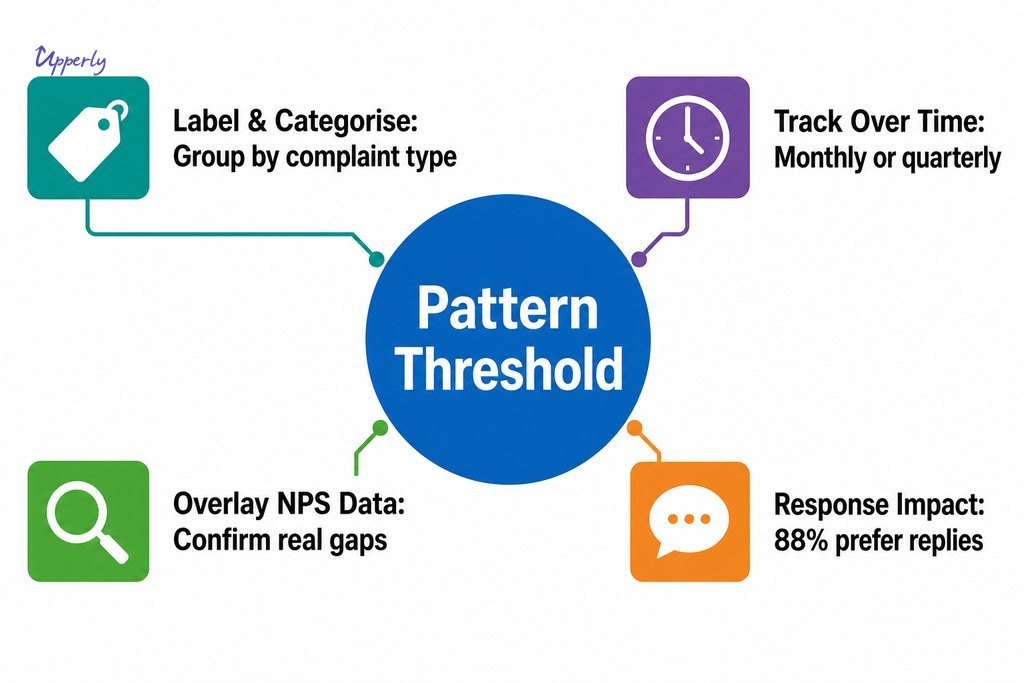
Step 1: Export and label your reviews. Pull reviews from Google, Facebook, Yelp, and any other platforms where your business appears. Assign each one a primary complaint label — wait times, communication gaps, product quality, staff interaction, billing confusion, or whatever categories match your service model.
Step 2: Look for statistical weight. Once you have at least twenty to thirty labelled reviews in a given period, patterns begin to emerge. Below that volume, single incidents can skew your reading, so treat smaller samples as directional rather than conclusive.
Step 3: Sort by time period. Detect whether a complaint cluster is growing, stable, or fading. A spike in communication complaints following a team restructure tells a very different story than the same feedback appearing consistently over eighteen months.
Complaint themes that appear across both time periods and different reviewers deserve prioritised attention and formal root-cause investigation.
| Step | Action | What It Reveals |
|---|---|---|
| Step 1 | Export and label reviews by complaint category | Which issues are appearing and how frequently |
| Step 2 | Look for statistical weight (20 to 30 or more reviews) | Whether a complaint is systemic or an isolated incident |
| Step 3 | Sort complaints by time period | Whether a pattern is growing, stable, or fading |
What to Track Beyond Star Ratings
Star ratings give you a number, but they rarely explain why. The more useful signals are qualitative: the specific language reviewers use, when complaints spike relative to your operations, and whether the same phrasing recurs across unrelated customers.
When multiple reviewers independently write phrases like “no one followed up” or “I had to call three times,” that repetition is doing important diagnostic work. A study published by PLOS One found that online ratings follow systematic polarisation patterns, and that reviewer behaviour across multiple reviews carries deeper operational insight than individual scores examined in isolation. The words your unhappy customers choose are worth as much as the stars they assign.
Using NPS Data Alongside Public Reviews
Public reviews represent customers who were motivated enough to post publicly, which means they skew toward either strong satisfaction or strong frustration. Net Promoter Score surveys capture a broader slice of your customer base, including the quietly dissatisfied middle group who rarely post anywhere.
When you overlay NPS results with your public review trends, you get a more complete picture of where sentiment is breaking down across the full customer journey. If your NPS scores are dropping in a category that also shows rising complaints in public reviews, that convergence is a strong signal of a genuine operational gap rather than an isolated incident. Upperly’s NPS survey tools are designed to surface exactly this kind of combined insight, making it easier to spot the disconnect between what customers say privately and what they are willing to say publicly.
How to Engage with Negative Review Patterns Without Getting Defensive
One of the most consistent obstacles to effective review pattern analysis is internal defensiveness. When a pattern of complaints clearly points to a specific location, team, or employee, the instinct to protect colleagues can override the willingness to engage honestly with the data.
The key reframe is this: review pattern insights are operational intelligence, not personal accusations. They tell you where a process is failing, not necessarily who is responsible for that failure.
The practical approach is to present pattern findings in the same language you would use for any other performance metric. Complaints about a specific service stage are a data point. They prompt investigation, not immediate judgment. When teams understand that the goal is to fix the system rather than assign fault, resistance tends to drop and engagement with the data tends to rise.
According to BrightLocal, 88% of customers prefer businesses that reply to all their reviews, positive and negative, compared to only 47% who would accept businesses that do not respond at all. In a competitive market like Vancouver, where customers across neighbourhoods from Kitsilano to Commercial Drive have no shortage of alternatives, that expectation can only be met when internal teams are willing to engage with the feedback honestly.

Mapping Review Trends to Specific Operational Gaps
Once you have identified recurring complaint themes, the next step is tracing each one back to a specific process, workflow, or communication failure.
A pattern of complaints about long wait times might connect to understaffing at peak hours, a booking system that allows overbooking, or a front-line team that lacks the tools to communicate delays proactively. The complaint is the symptom. The operational gap is the cause, and finding it requires working backwards from the review text into your actual service delivery process.
A simple tracking framework makes this mapping repeatable: assign each complaint category to an internal process owner, log the volume and frequency of related complaints, and set a review cadence to assess whether process changes produce measurable reductions in complaint rate. Customer issue tracking only becomes meaningful when it is connected to someone accountable for the underlying workflow.
| Complaint Pattern | Likely Operational Gap | Suggested Action |
|---|---|---|
| Long wait times | Understaffing at peak hours or overbooking system | Review scheduling workflows and booking capacity limits |
| No one followed up | Missing post-interaction communication process | Implement automated follow-up at a defined interval post-interaction |
| Billing confusion | Unclear invoicing or payment communication | Review billing documentation and staff communication scripts |
| Inconsistent staff interaction | Training gap or performance issue at team level | Use employee-level feedback tools to isolate and address the gap |
When the Same Complaint Points to an Employee-Level Issue
Some complaint patterns are not process-level problems. They are people-level signals. When multiple reviews reference a consistent interaction style, a communication gap, or a failure to follow through, and those reviews correlate with a particular staff member or team, that is a training or performance conversation, not just a service redesign project.
This level of granularity is rarely visible through public reviews alone, because most customers do not name employees and most review platforms do not support that kind of filtering. Employee-specific feedback tools, like the ones Upperly provides, make this visible much earlier by collecting feedback tied to individual team members through direct post-interaction surveys. That data allows managers to identify performance gaps before they accumulate in public review threads.
Turning Review Analysis into Measurable Service Improvements
Identifying a pattern is only useful if it leads to action. The output of any negative review analysis cycle should be a short list of prioritised issues, each with a defined owner, a planned intervention, and a metric that will indicate improvement.
For example, if your complaint analysis shows a consistent pattern around post-sale communication, the action item might be implementing an automated follow-up sequence at seventy-two hours post-purchase, with success measured by a reduction in communication-related complaints over the following quarter.
Review trends only stay visible if you maintain a consistent cadence of analysis. A monthly or quarterly review audit, where complaint categories are re-counted and compared to the previous period, transforms review data from a reactive problem log into a forward-looking performance indicator. According to Qualtrics XM Institute, 94% of consumers say they have avoided a brand because of negative reviews, which means unresolved complaint patterns carry a direct and compounding cost. Treating review cadence as a standing operational process, rather than an ad hoc task, is what separates businesses that improve their scores from those that simply manage their responses.
What to Verify Before Drawing Conclusions from Review Data
Review data is valuable, but it has real limitations that should shape how you interpret it.
Watch for sample bias. Reviewers who post publicly skew toward emotionally activated experiences. The silent majority, customers who were satisfied or mildly disappointed, rarely appear in the dataset at all. This can make certain complaint types look more prevalent than they actually are. Before escalating a finding to senior leadership or restructuring a workflow, validate the pattern against direct customer survey data, support ticket logs, or operational records that reflect a broader cross-section of experiences.
Watch for review gating. If your review collection process filters out dissatisfied customers before they ever reach a review prompt, your public profile will look healthier than your actual service quality warrants. Understanding how to reduce negative reviews with better follow-up is different from suppressing them. Genuine follow-up that resolves issues before frustration peaks is a legitimate service improvement, but artificially filtering feedback creates a misleading picture that prevents the very analysis this article is built on.
Building a Feedback System That Makes Patterns Easier to Spot
Consistent, high-volume feedback collection is the prerequisite for reliable pattern detection. When reviews arrive sporadically or only from customers who sought out the review form themselves, the sample is too small and too self-selected to reveal meaningful trends.
Automated review collection, where feedback requests are sent systematically after every qualifying interaction, produces the data volume that makes trend analysis statistically valid. It also reduces the recency bias that comes from relying on whichever customers happened to feel strongly enough to post without prompting. For Vancouver businesses serving customers across multiple locations or a broad metro service area, this consistency matters even more: patterns can easily be masked by location-level variation if feedback volume is uneven.
Upperly’s automated review collection and NPS survey tools are built around exactly this need. By sending structured feedback requests at consistent points in the customer journey, and by offering flexible collection options that work across email and multiple review platforms, the platform creates a continuous stream of comparable data that Customer Experience Managers can analyse month over month without adding manual workload. The result is a feedback system that does not just capture individual opinions. It builds the longitudinal record that makes real pattern analysis possible.
If your team is ready to move from reactive review management to structured insight, that shift starts with the data infrastructure underneath it. Upperly makes it straightforward to set that infrastructure up. Explore the platform and see how consistent, automated feedback collection can give your team the review trends it needs to act with confidence.
Frequently Asked Questions About Negative Review Patterns
What is a negative review pattern?
A negative review pattern is a recurring theme or complaint that appears consistently across multiple customer reviews over time. Unlike a one-off complaint, a pattern indicates a systemic issue, such as a process failure, a communication gap, or a training deficit, that affects more than one customer interaction.
How many reviews do you need before a pattern becomes meaningful?
A reliable pattern typically requires at least twenty to thirty reviews within a defined time period. Smaller samples can reflect individual incidents rather than systemic issues, so treat data below that threshold as directional guidance rather than conclusive evidence.
What complaint categories should businesses track in reviews?
The most useful categories depend on your service model, but common ones include wait times, staff communication, billing clarity, follow-up consistency, and product or service quality. Assigning each review a primary category label makes it possible to count and compare complaint types over time.
How do NPS scores relate to public review patterns?
NPS surveys capture feedback from a broader customer base, including those who are mildly dissatisfied but unlikely to post publicly. When NPS scores drop in the same area where public complaints are rising, that overlap is a strong indicator of a genuine operational gap rather than an outlier complaint.
What is the difference between resolving negative reviews and suppressing them?
Resolving a negative review means addressing the customer’s underlying issue through genuine follow-up before or after it is posted. Suppressing a review means filtering out dissatisfied customers so their feedback never reaches a public platform. The first improves service quality; the second distorts your data and prevents meaningful pattern analysis.
How often should businesses audit their review data for patterns?
A monthly or quarterly audit cadence works well for most businesses. Re-counting complaint categories each period and comparing them to the previous period allows teams to track whether process changes are producing measurable improvements in specific complaint areas.
Social Share


How to Choose NPS Software That Drives Real Retention
Key Takeaways A structured framework for CX managers in Vancouver to evaluate NPS software based on delivery, reporting, CASL compliance, pricing, and setup support for…


Strategies to Improve Customer Retention
Customer retention is the most important issue for all companies. If you want your business always to be successful, you should pay a lot of…

Why Fresh Reviews Shape Customer Trust and Sales
Key Takeaways Review recency directly shapes buyer trust and conversions, with 97% of consumers considering freshness at least somewhat important when making a purchase decision.…

How to Choose Review Management Tools That Drive Results
Key Takeaways Upperly outlines a practical, goal-first framework to help Vancouver marketing teams choose review management tools that deliver measurable results. Start by auditing your…